
“I eat tons of fiber, but my constipation never really gets better.” If that sounds familiar, you are not alone. Here is the missing piece almost no one mentions: fiber is not one thing. It is two completely different things, and the balance between them is what actually shapes me. Today I want to walk you through both types, and the simplest way to get them into your meals starting today.
The Origin of This Quote
Fiber splits into two big families: soluble and insoluble. The names are literal — one dissolves in water, the other does not — and inside the gut, they do completely different jobs.
Soluble fiber dissolves into a soft gel when it meets water, and that gel keeps poop soft and easy to pass. Once it reaches the large intestine, it also feeds the good bacteria, which in turn produce short-chain fatty acids that help the gut wall stay healthy. Foods rich in soluble fiber: seaweed, oats, barley, konjac, bananas and other fruits, sticky vegetables like okra, natto, and yams.
Insoluble fiber absorbs water and physically swells, adding bulk to your poop. That bulk pushes against the gut wall and stimulates peristalsis — the wave-like motion that moves things forward. Foods rich in insoluble fiber: most vegetables, mushrooms, brown rice and whole grains, beans, and root vegetables.
The crucial part most articles skip: eating only one of them can backfire. Loading up on insoluble fiber alone makes poop drier and harder, which can make constipation worse, not better. Going all-in on soluble fiber alone makes poop too loose to hold any shape. Only when both show up together do I become the banana shape everyone wants. The textbook ideal ratio is 1 part soluble to 2 parts insoluble — sometimes called the golden ratio of fiber.
Unchikun’s Take
The way I see it, soluble and insoluble are a duo: one is the “softness crew” and the other is the “bulk crew.” If only the softness crew shows up, I turn into a shapeless blob. If only the bulk crew shows up, I get rough and scratchy and uncomfortable on the way out. Only when both work together do I come out looking like the proud banana the textbooks talk about.
This is exactly why people who load up on salads or switch to brown rice sometimes find their constipation getting worse, not better. Salads and brown rice are almost entirely insoluble. They are recruiting the bulk crew without anyone on the softness crew, so I just stay hard and stuck.
The opposite trap is real too. People drinking seaweed soup or eating lots of mozuku every day are recruiting the softness crew but forgetting the bulk crew. The stool stays loose, but it never builds up enough volume to fully evacuate, so the body keeps holding onto leftovers.
The rule is not “eat more fiber.” The rule is “eat both kinds, every day.” A realistic version of this is: at every meal, make sure at least one of the two shows up. That is it.
One Thing You Can Do Today
For the next three meals, add one fiber item — soluble or insoluble — to each meal on purpose. Here is what that can look like:
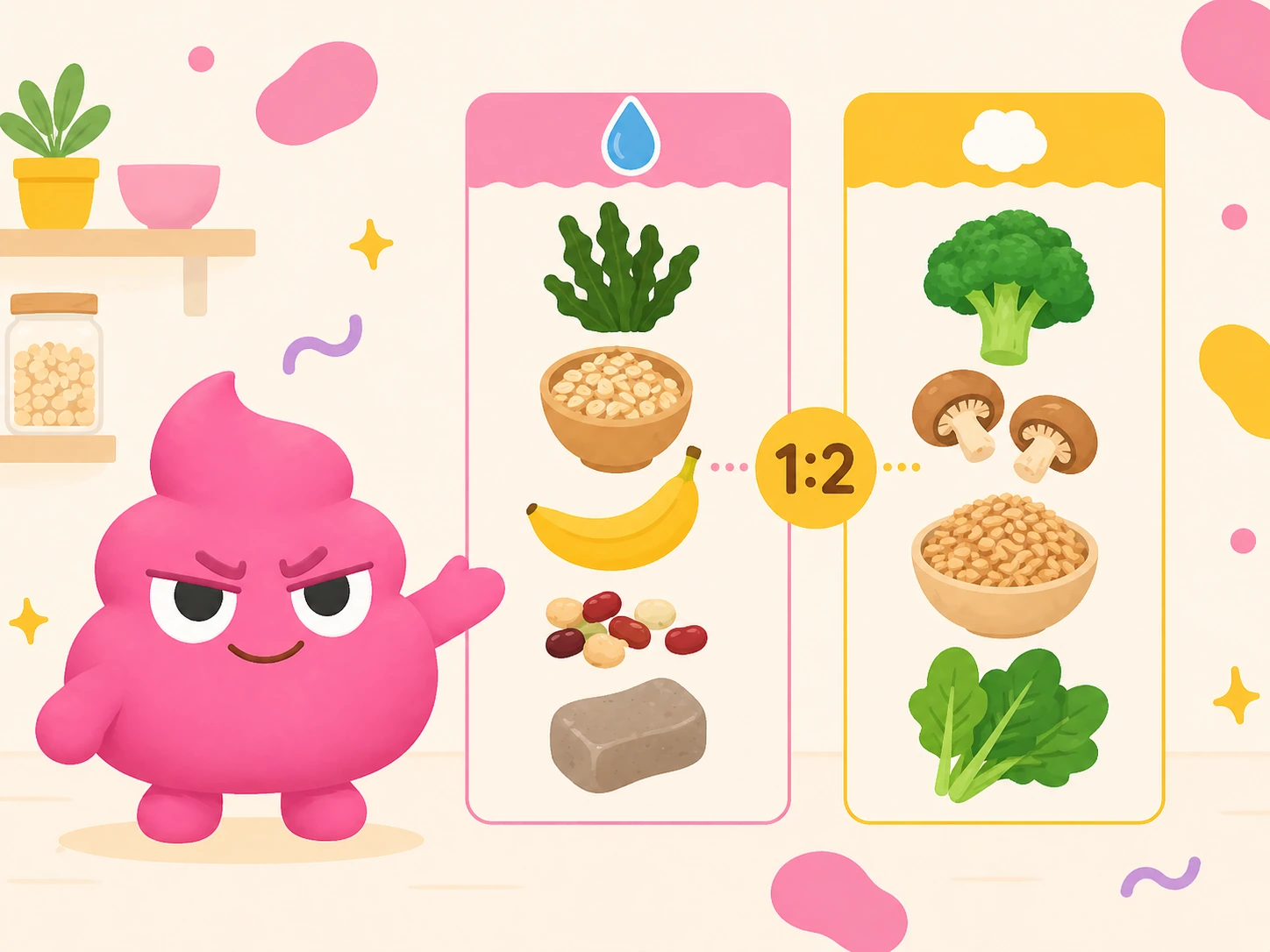
Breakfast: Switch white rice or white toast to oats or whole-grain bread (insoluble) + add a banana on the side (soluble). Two kinds, one bowl. Lunch: Add seaweed to your miso soup or salad (soluble) + put mushrooms or leafy greens on your plate (insoluble). If you eat at convenience stores, grab a hijiki or seaweed side dish next to your rice ball. Dinner: Put natto or okra on your rice (soluble) + serve a stir-fry of vegetables or mushrooms as the main side (insoluble). Or make a miso soup with both daikon and wakame.
Do not aim for perfect. Just glance back at your day and ask: did soluble and insoluble both show up? If you tend to lean hard on one side — “I only eat salads” or “I only eat brown rice” — start by intentionally adding one soluble food (seaweed, oats, fruit, beans, natto) to one meal. The shift in my shape can be surprisingly fast.
If you log my daily shape in the unchikun app, you will start to see the difference between weeks where you got both types in versus weeks where you forgot. That kind of gentle pattern-spotting is often what turns a vague intention into a real habit.
Summary
Fiber is not one thing — it is a duo. The softness crew (soluble) and the bulk crew (insoluble) only do their best work as a pair. Tomorrow, glance at your plate and ask: which of the two is missing? Then quietly add one item to fix the balance. That is honestly all it takes.