Have you ever held it in “just for now” during a meeting or on a train? Almost everyone does, but if you keep doing it, my signal slowly stops reaching you, and that subtle shift can have a surprisingly real impact on your daily life. Today, let me walk you through exactly how that happens inside your body, and how to stay on good terms with me.
The Origin of This Quote
Do you know how the urge to go is actually generated? When I make my way through your colon and arrive at the rectum, sensors in the rectal wall send a signal to your brain saying “stool has arrived, time to go.” Your brain receives that and produces the familiar “I need to go” sensation. This whole loop is called the defecation reflex, and it is a perfectly normal physiological process that runs in the background of every healthy gut.
But when you hold it in because of work, social awkwardness, or just inconvenient timing, I stay parked in the rectum. Here is where the trouble begins. When the rectum repeatedly experiences “stool present, but no exit,” its sensors gradually lose sensitivity. Eventually, even when stool is there, the brain stops getting the message clearly. This state has a name — rectal-type constipation.
Rectal-type constipation is one of the three major types of constipation, alongside atonic (lazy gut) and spastic types. It is especially common among young women and busy professionals. The cause is not really a “disease” — it is a “habit of holding it.” In a way, this is constipation that you slowly and unintentionally create yourself.
Unchikun’s Take
The urge to go, you know, is basically a little letter from me saying “stuff is on the way, please head to the bathroom.” But if you reply with “later” too many times, I gradually start sending fainter and fainter signals. The gut is a smart, adaptive organ — it keeps adjusting itself to match your actual lifestyle patterns, whether you want it to or not.
I get it, especially in places like school or work, where going to the bathroom can feel a bit awkward or “not the right moment.” It makes sense to suppress the urge in the moment. But if you zoom out, those small daily suppressions add up over months and years, and you end up gradually dulling the very signals you would want your body to send loudly. A tiny compromise repeated daily becomes a very real cost over time.
The good news is, you can absolutely turn this around. Stop the holding habit, respond to the signals as they come, and within a few weeks to a few months, rectal sensitivity tends to return. Your gut, honestly, is much more eager to follow your lead than you might think. It has just been quietly adapting to whatever you have been teaching it through your daily choices, and it can re-learn just as readily once you start sending it different signals.
One Thing You Can Do Today
When you feel the urge, try to make it to the bathroom within three minutes. The rule is not about being perfect, and it is not about turning every signal into a panic. It is about treating “holding it” as something you actively avoid by default, instead of as an everyday compromise you barely notice making.
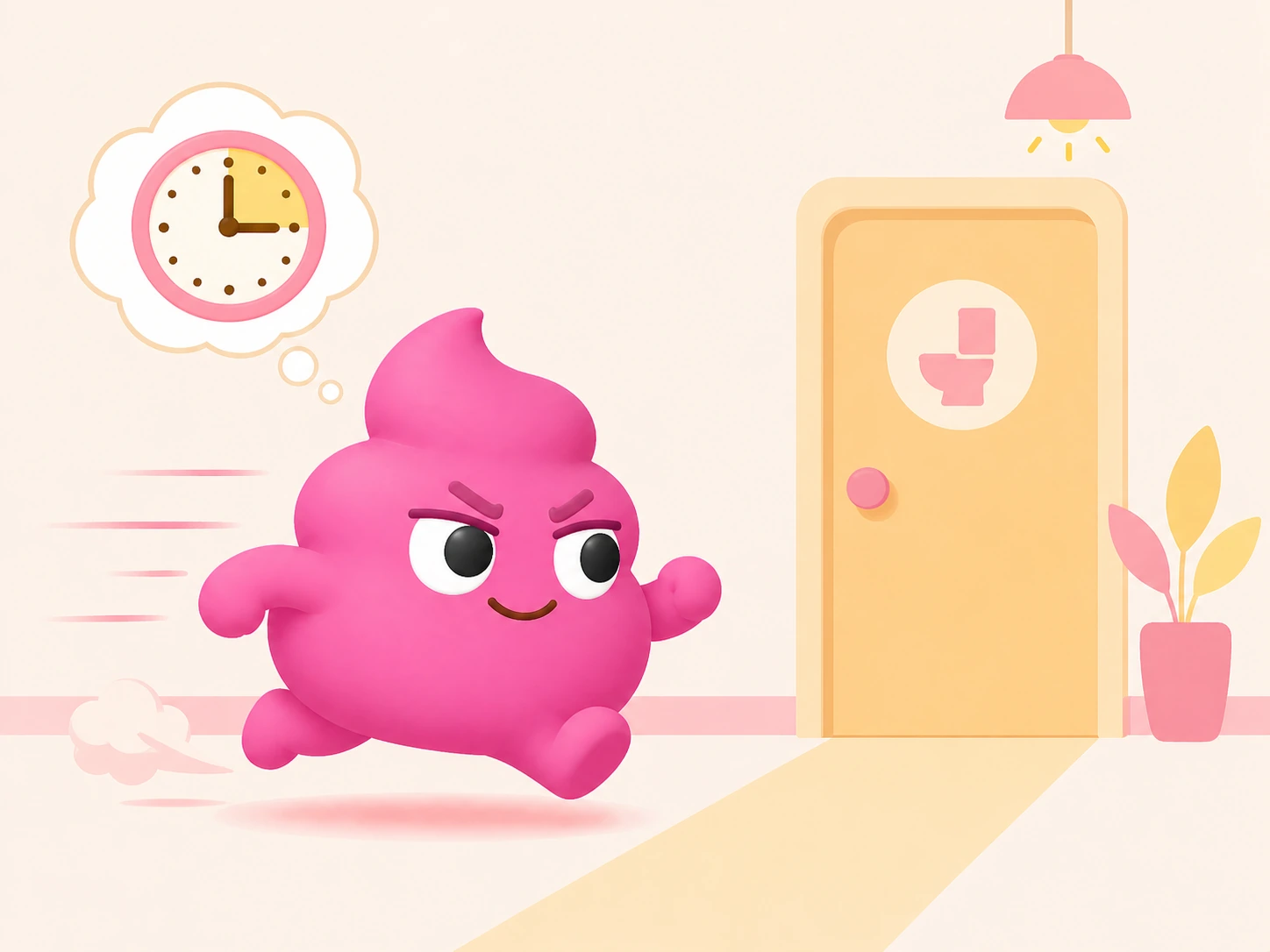
A particularly important one is the urge that comes right after waking up. When you wake up and eat breakfast, the gastrocolic reflex naturally pushes me along your colon. This is one of the most natural “go times” of the entire day, so do your best not to miss it just because of an early meeting or a packed morning. Going once at the right moment beats putting it off five separate times across the day. Less load on your body, less mental friction, and honestly less time spent overall.
If you log your bathroom times in the unchikun app, your body’s natural rhythm becomes visible over a few weeks, and you start seeing patterns of “when the urge usually shows up.” Once that is clear, you can start scheduling your day to follow your body instead of fighting it, and the small daily choices stop feeling like a struggle.
Summary
The urge is not something to suppress — it is something to listen to. Each time you respond to it builds a little more trust between you and your gut, and over weeks and months that trust shapes what your body decides to ask for next. Why not start today by saying yes to just one urge that you would normally have ignored? It is a small act, but the gut absolutely remembers, and the next signal will be a little easier and a little clearer to hear.