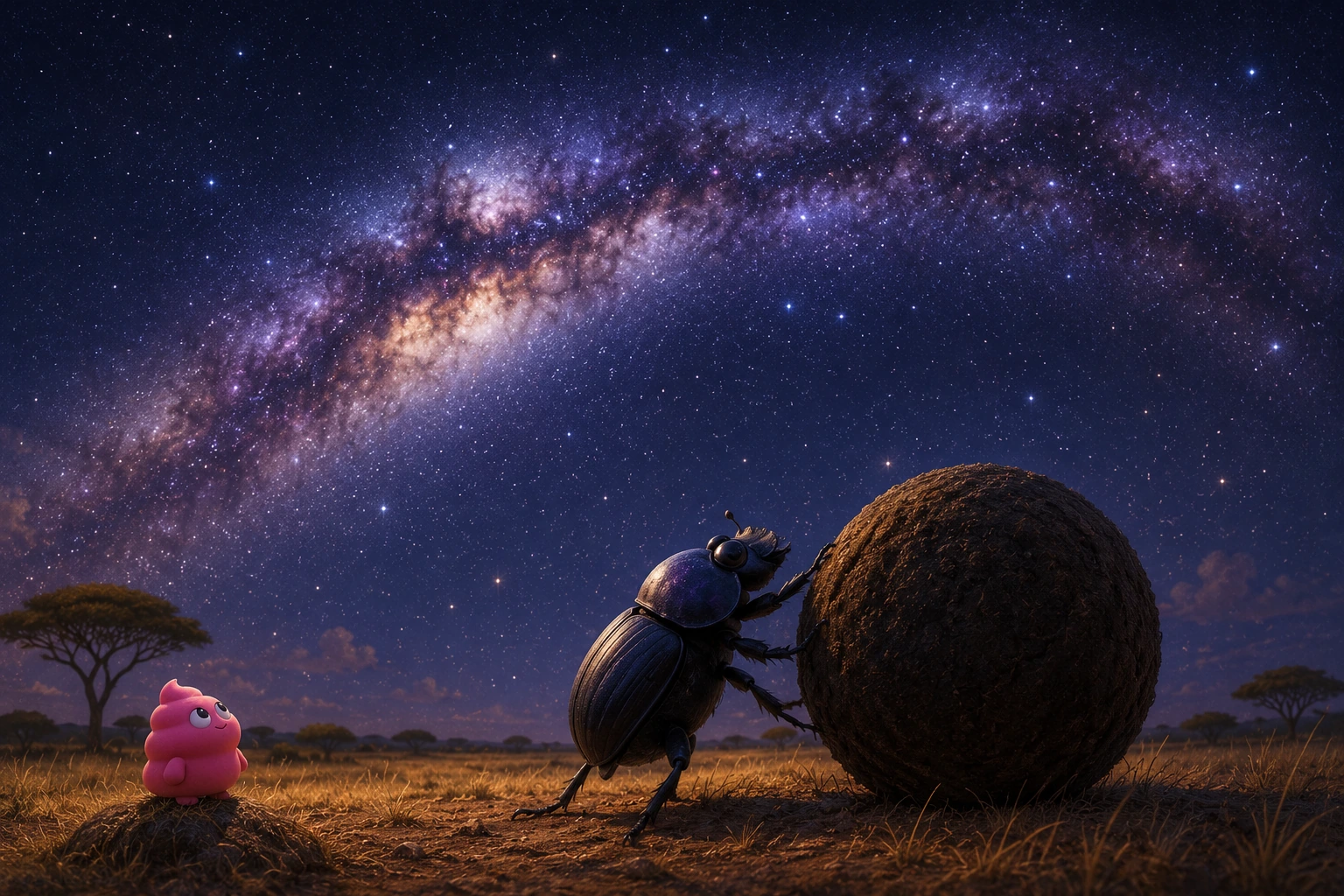
On a moonless night in the African savanna, my little cousin the dung beetle walks across the sand pushing a ball of poop bigger than its own body — and never, ever turns. No moon, no sun, no landmarks. Just sand, starlight, and a straight line. Today I want to tell you a true science mystery: how a tiny insect uses the Milky Way as its compass.
The Origin of This Quote
The African dung beetle Scarabaeus satyrus has one job in life: when a larger animal drops fresh dung, find it, shape a piece into a perfectly smooth ball, and roll it away to bury. Some beetles use it to attract a mate, some lay eggs inside it. Either way, that ball is everything.
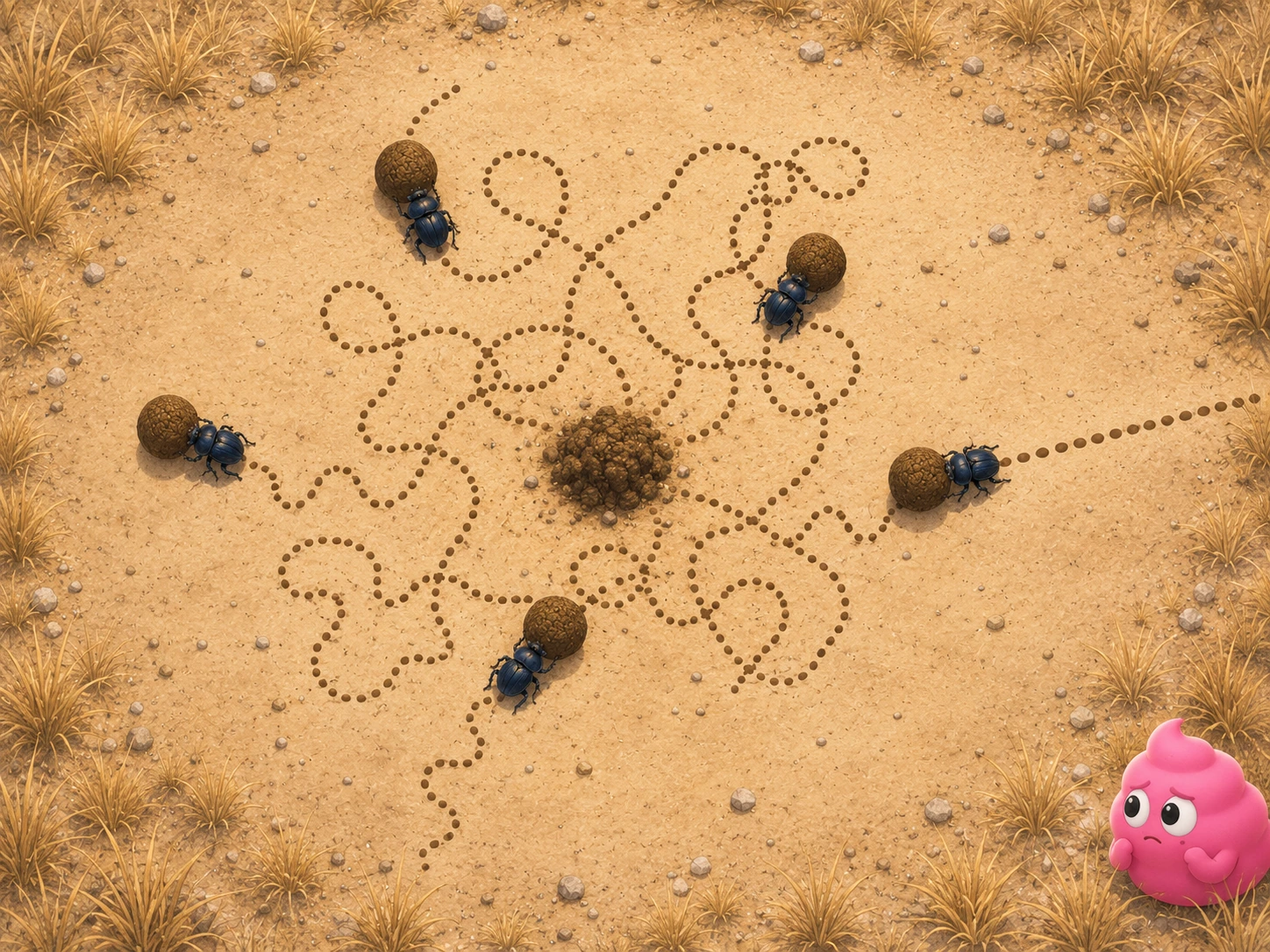
There is one unbreakable rule of this game. The beetle must roll its ball in a straight line. Why? Because the dung pile is a battlefield. Every other beetle in the neighborhood is rushing in to steal, and the longer you stay near the pile, the more likely you lose your ball. The fastest way out is a straight line, and the straightest line is the safest one.
But here’s the puzzle scientists couldn’t crack for years: even on a moonless night, with only faint starlight, dung beetles still roll perfectly straight. How does a tiny insect with a tiny brain navigate a black desert without any obvious landmark?
In 2013, Marie Dacke and her team at Lund University in Sweden answered the question with a beautifully absurd experiment. They brought dung beetles into a planetarium in South Africa. They projected a full starry sky on the dome. Then just the Milky Way. Then random stars scattered around. And they measured how straight each beetle could roll its ball under each sky.
The result: only when the Milky Way was visible did the beetles walk in straight lines. Random scattered stars weren’t enough. The beetles wandered in confused circles. The paper landed in Current Biology and stunned the field of animal navigation. That same year, the research won an Ig Nobel Prize — the award for science that “makes you laugh, then makes you think.”
Unchikun’s Take
The discovery rewrote the rules. Until then, scientists believed that using stars to navigate was a trick reserved for big-brained animals — migrating birds, seals, humans. The idea that an insect with a brain the size of a poppy seed could read the band of the Milky Way as a directional cue was unthinkable.
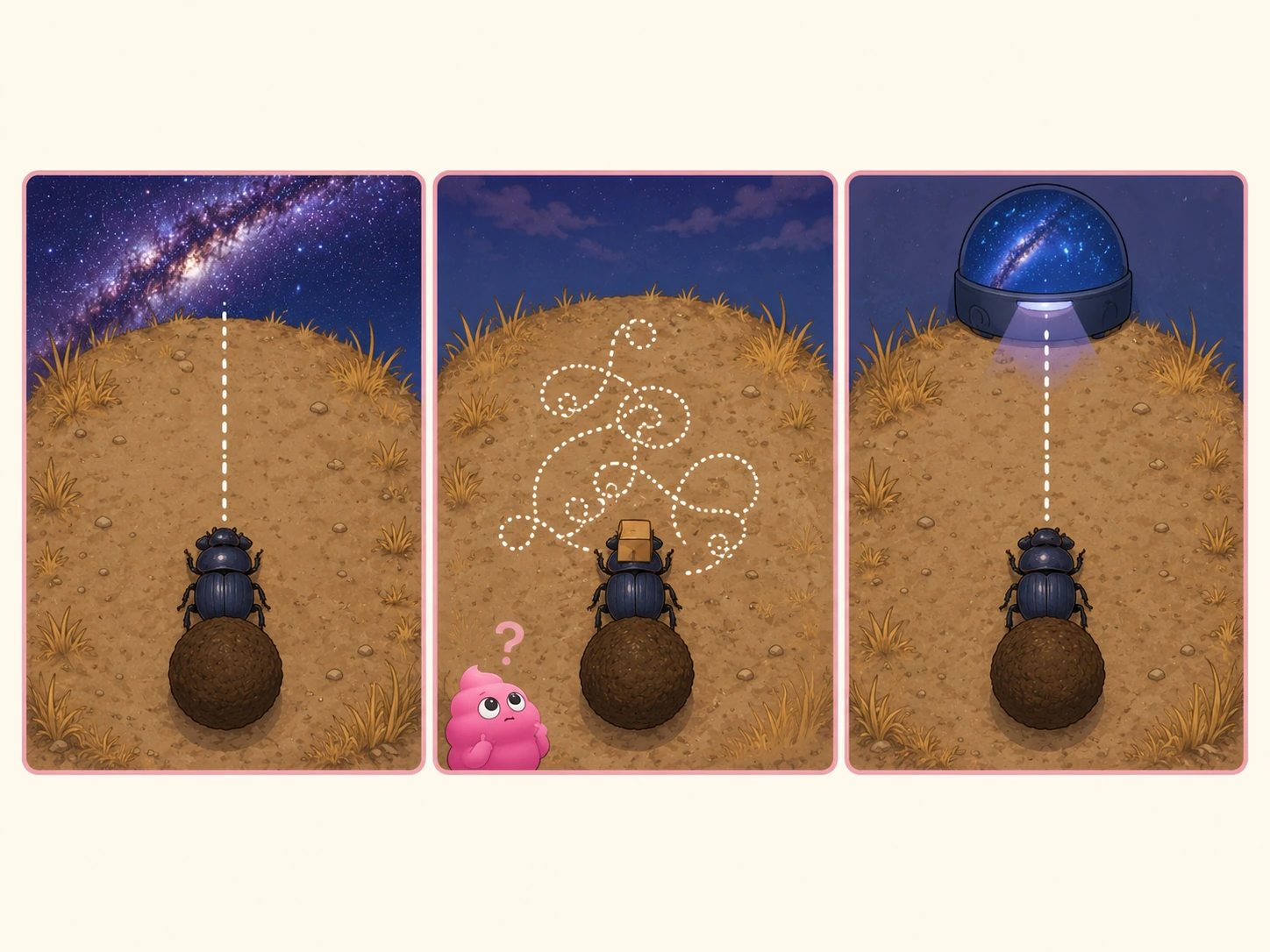
The team had run an even more mischievous earlier experiment: they glued tiny cardboard caps onto the beetles’ heads to block their view of the sky. The moment the sky disappeared, the beetles spiraled aimlessly. The cue was clearly above them, not on the ground. From there, the planetarium experiment narrowed it down to that one soft glowing band.
It gets better. Dung beetles, it turns out, switch between at least four different celestial compasses depending on the time of day: the sun when it’s bright, polarized light at twilight, the moon on lit nights, and the Milky Way on moonless ones. One tiny beetle. Four different ways of reading the sky.
And here’s the part I love most. The beetle has no idea what the Milky Way actually is. It doesn’t know it’s looking at 200 billion stars in our home galaxy. It just sees a faint stripe of light and uses it as a guide pointing “that way.” For millions of years, that’s been enough.
The tiny insect we casually labeled “the bug that rolls poop” might be the first animal on Earth to ever use the galaxy as a compass. Doesn’t that feel a little too romantic to be real?
One Thing You Can Do Today
The dung beetle reaches its goal by switching cues — sun, moon, polarized light, the Milky Way. But sometimes the sky is cloudy. Sometimes a storm rolls in. The reason the beetle still survives isn’t a single perfect night. It’s the habit of finding some signal, every night, no matter what.
Your gut is the same. A single day’s poop won’t tell you anything. Color, shape, frequency all shift with stress, travel, sleep, and meals. But log it daily, and your own Milky Way starts to form overhead — a soft stripe of pattern across weeks and months.
“My stool gets harder for three days after I travel.” “When I sleep less than six hours, I always see this shape.” “Heavy meat days look like this, plant-heavy days look like that.” Those are your stars. Connect enough of them and you become the navigator of your own body.
When you log entries in the Unchikun app, every record is one star. Six months in, you’ll be reading the galaxy your gut is broadcasting.
Summary
In the African savanna at night, the dung beetle looks up at the Milky Way and rolls its ball home in a straight line. It’s the first known case of galactic navigation on Earth — and the navigator is a tiny insect with a tiny brain and a ball of poop. Next time you stand under a moonless sky, look up and remember: somewhere out there, a small cousin of mine is walking straight under the same band of light, never once looking down.