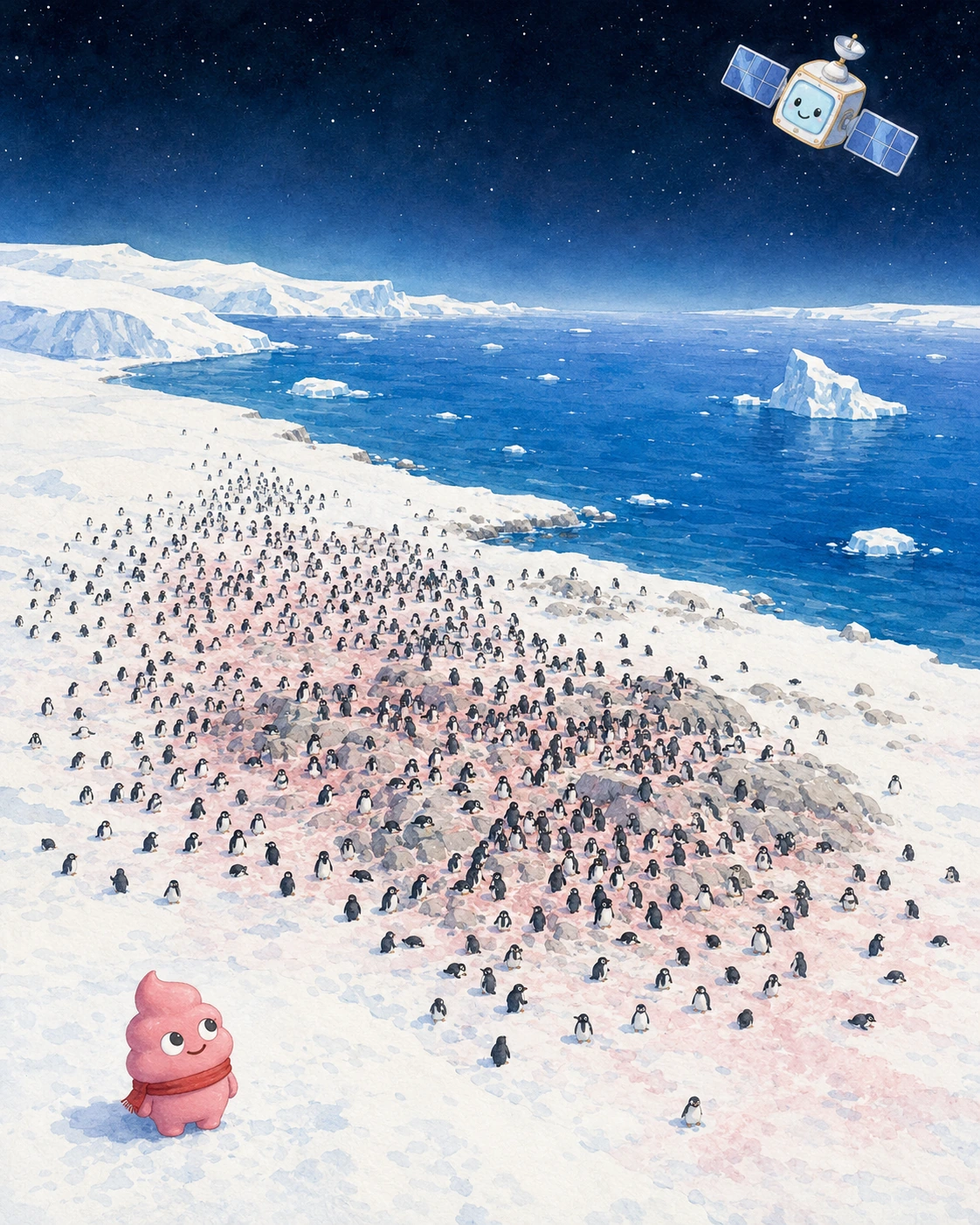
If you look down at Antarctica from orbit, the white coastline doesn’t stay completely white. There are faint pink stains scattered across the snow — and every single one of them is penguin poop. Today I want to tell you a beautifully ridiculous true story: humans now count penguins by looking at their poop from outer space.
The Origin of This Quote
Antarctica is home to millions of Adélie penguins, who gather on the rocky shoreline every summer to breed, lay eggs, and raise their chicks. They waddle back and forth from sea to land all day long, and they poop just like me — a lot.
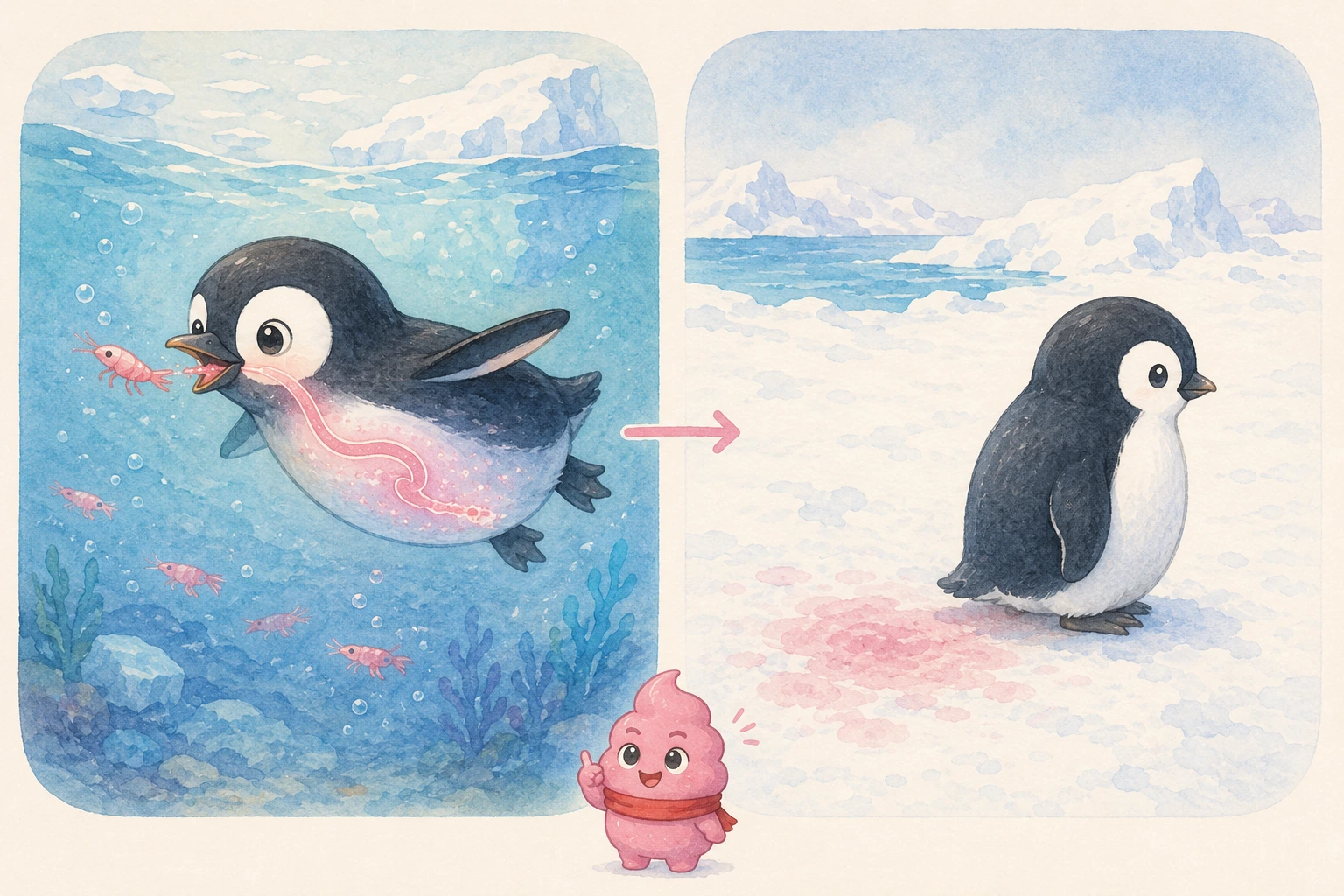
Here’s the twist. Adélie penguins eat almost exclusively krill, a small pink crustacean rich in a red pigment called astaxanthin. That pigment passes through the penguin’s gut almost unchanged and ends up in their guano. Thousands of pooping penguins on the same patch of snow create a bright pink carpet that stretches for hundreds of meters.
That carpet is visible from space.
In 2009, British Antarctic Survey researcher Peter Fretwell and his team analyzed NASA Landsat satellite images of the entire Antarctic coast, looking specifically for those pink-stained patches. By “reading the poop,” they mapped penguin colonies all the way around the continent — and discovered new colonies humans had never seen before. Then in 2018, the same method led to the discovery of a hidden supercolony of about 1.5 million Adélie penguins on the Danger Islands, off the Antarctic Peninsula.
No one had to set foot on those islands. A satellite, hundreds of kilometers up, spotted a pink stain and said: something with about 1.5 million heartbeats lives here.
Unchikun’s Take
Let’s break down why this works. Krill are pink because of astaxanthin, the same antioxidant that gives flamingos and salmon their color. When a penguin eats krill nonstop for months, the pigment can’t all be digested, so a fraction comes straight out the other end. Multiply that by tens of thousands of birds in one spot, and you get pink snow that contrasts sharply against a planet-sized white background — exactly the kind of signal a satellite is good at picking up.
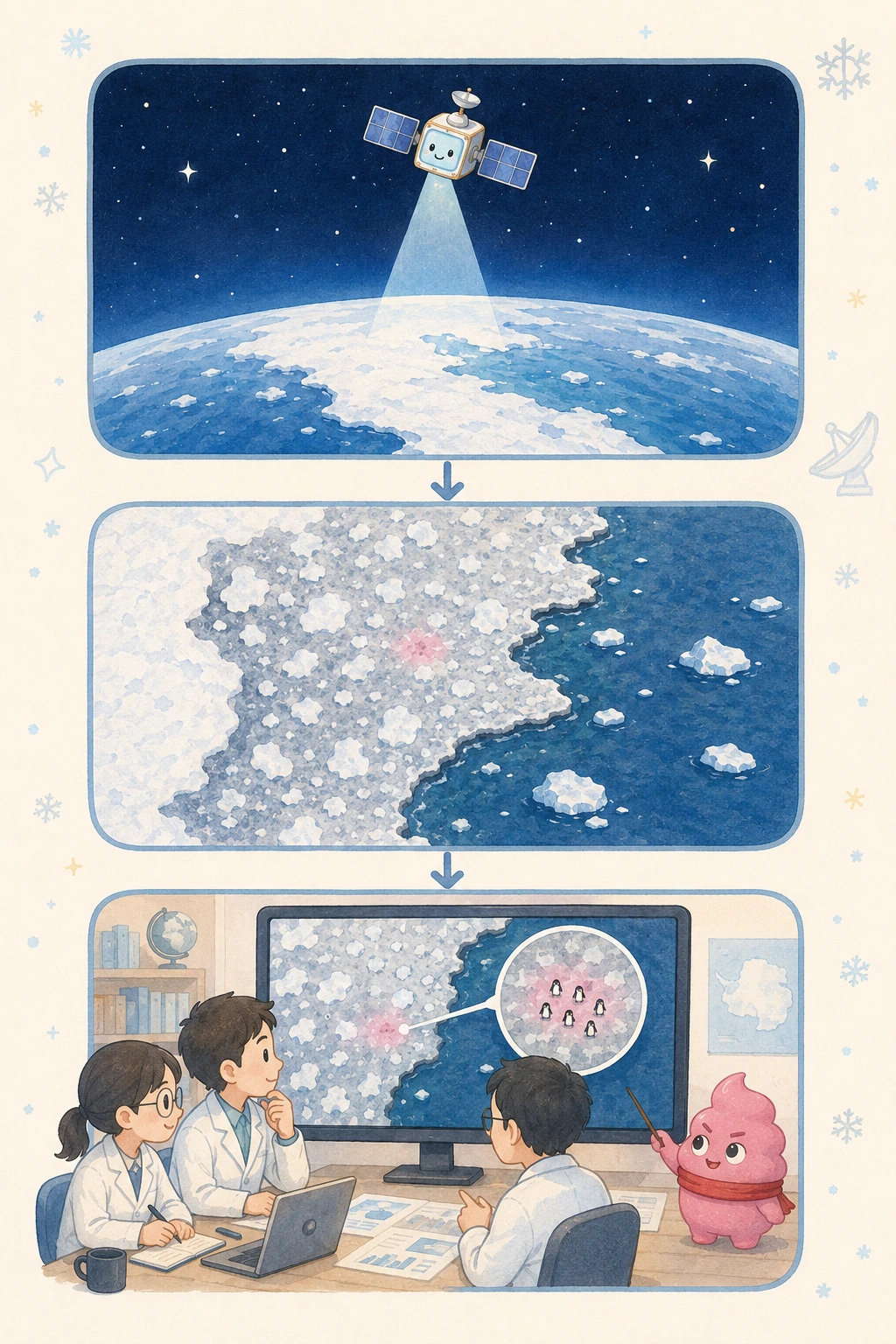
This is more than a cute trick. It turns penguin poop into a planetary-scale climate sensor. Adélie penguins are extremely sensitive to changes in sea ice and krill abundance. If the ocean warms, krill move, and colonies shrink. So if a research team measures how much pink area there is on the coastline each year, they can monitor the health of the entire Antarctic ecosystem without sending a single ship.
Until recently, surveying penguins meant months of expedition work, freezing fieldwork, and counting birds by hand. Now a Landsat pass can scan more colonies in a single afternoon than a human team could survey in a lifetime. It’s the largest census of life ever made possible by looking at poop.
Researchers now combine satellite data with drone surveys and even old explorers’ diaries to maintain a continent-wide penguin map that updates every year. When a new colony shows up, conservation groups can push for Marine Protected Areas that legally shield that stretch of ocean. In other words, a penguin’s poop becomes the legal marker that protects its home.
One Thing You Can Do Today
When you hear that penguin poop can be tracked from orbit, your own poop starts to feel a little more interesting, doesn’t it? Mine is small and I get flushed away in seconds — but my color, shape, and quantity carry the whole story of yesterday’s meal and today’s body, just like the pink stains carry a whole season of krill data.
Penguin guano tells satellites what the birds have been eating. Your poop tells you what you ate, how stressed you were, whether you drank enough water, and whether your gut is humming along happily today. Green-ish on a heavy-vegetable day, dark on an iron-supplement day, pale and floating after a fatty meal. Same principle, different scale — your body is broadcasting a daily report, and you don’t even need a satellite to read it.
When you log entries in the Unchikun app, you’re doing exactly what those satellite scientists do — collecting dots until they become a line. A single bowel movement is one pink stain. Six months of records is your personal Antarctic map.
Summary
The pink stains scattered across the silent Antarctic coast are little flags planted by my penguin cousins. Satellites in orbit can see them — and through them, count millions of lives. Poop isn’t shameful. It’s one of the most honest data points your body produces. Next time you see ice in your freezer, picture the pink-stained coast, and remember: somewhere south of the world, a penguin’s poop is quietly signaling to outer space, “We’re still here.”