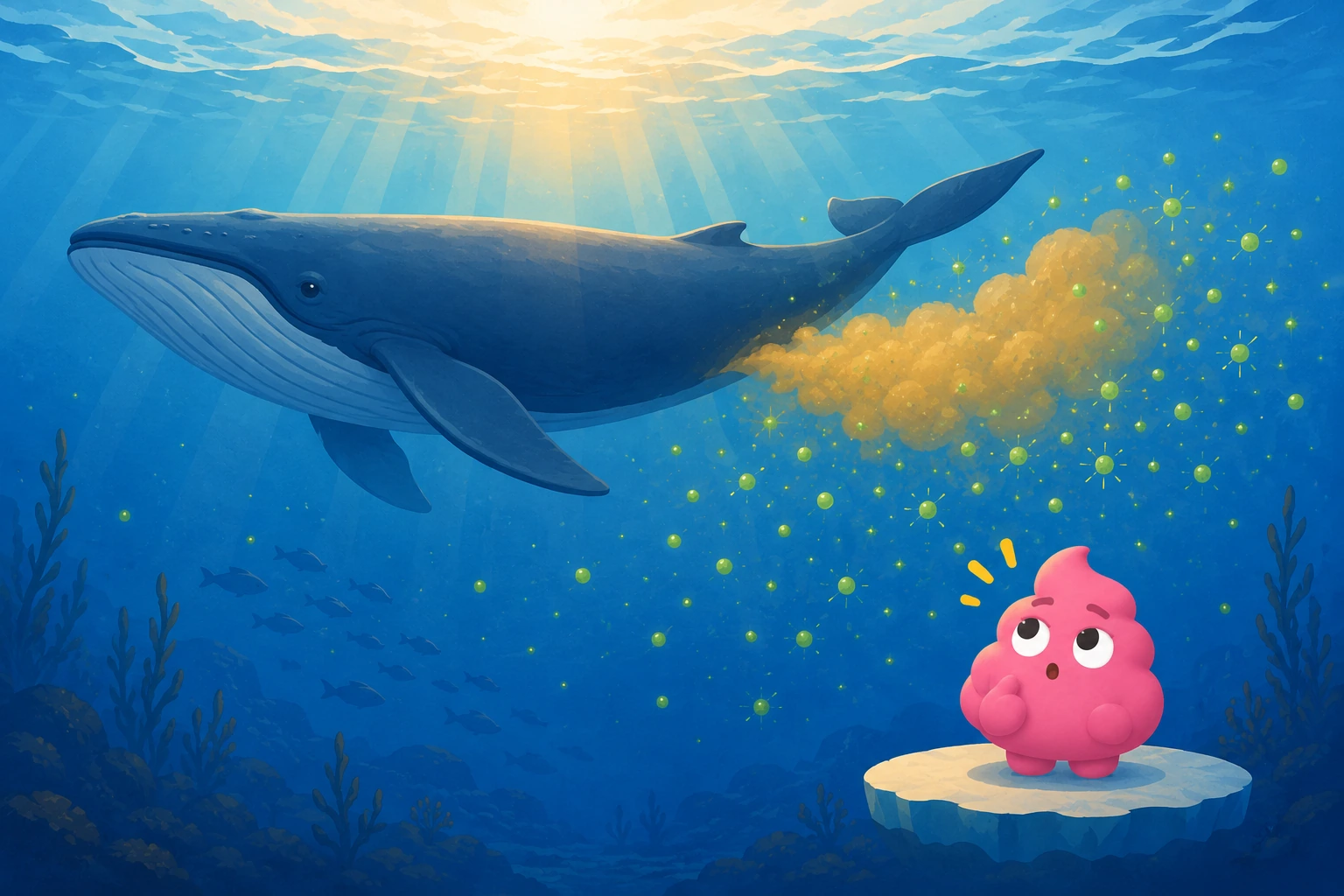
The largest animals on Earth are whales. Have you ever stopped to imagine what kind of poop a body that enormous makes every day? The honest answer is wild: a whale’s poop quietly feeds the entire ocean, on a scale that genuinely affects the planet. Today, let me walk you through the Whale Pump.
The Origin of This Quote
In 2010, biologists Joe Roman and James McCarthy published a paper called “The Whale Pump”. It was the first study to put real numbers on how whales circulate nutrients across the entire ocean.
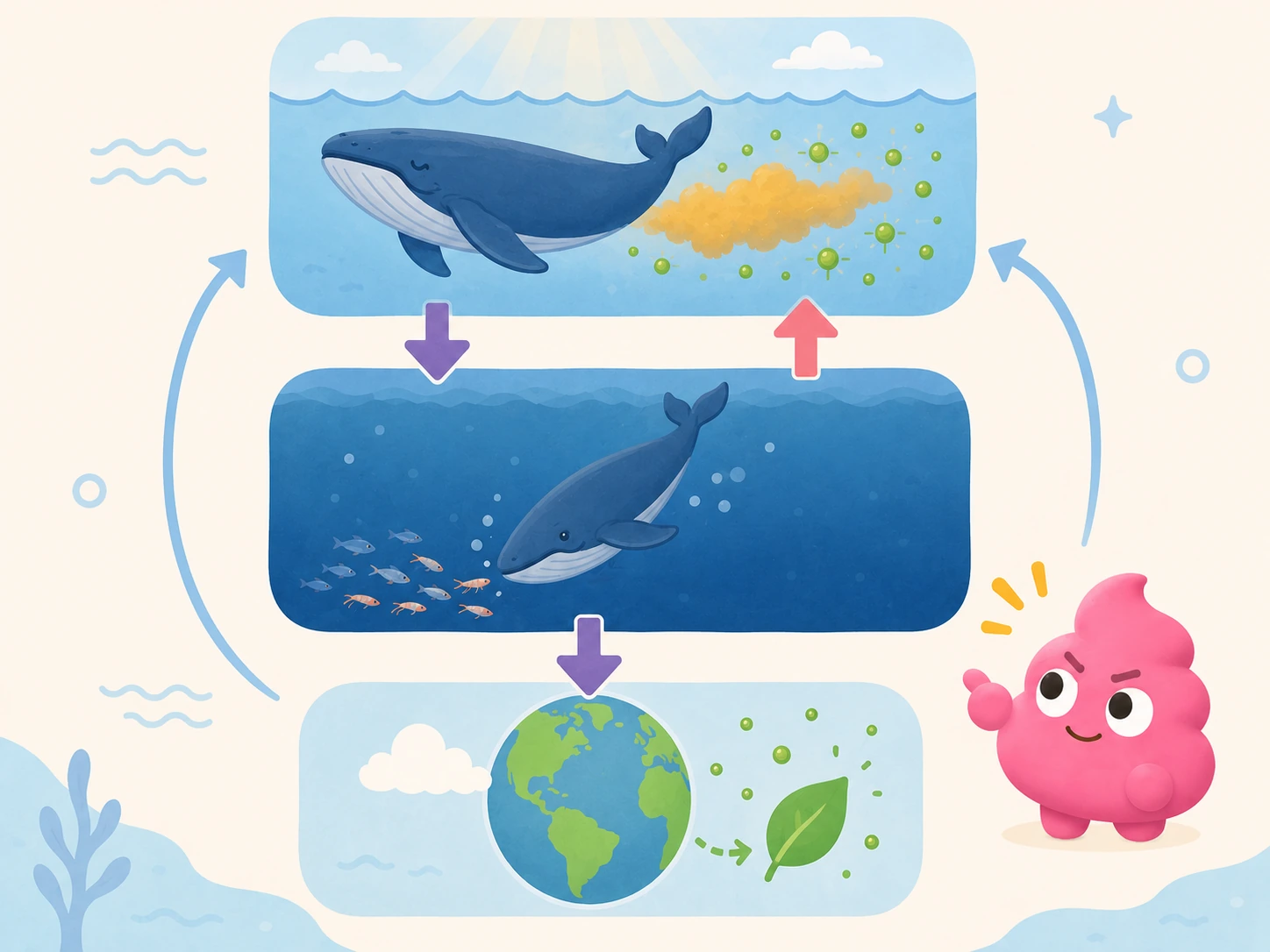
Whales have a very specific habit: they eat in the deep, and release waste near the surface. That single pattern matters enormously. In the ocean, key nutrients like iron and nitrogen tend to sink to the deep, leaving the sunlit upper layer hungry for them. Whales bring those nutrients back up in the form of nutrient-rich poop, acting like a giant pump that lifts food from below to above.
The contents of whale poop are extraordinarily nutrient-dense. Iron concentrations are reported to be more than ten thousand times that of the surrounding water, plus abundant nitrogen and phosphorus. Released near the surface, that mixture is exactly what tiny phytoplankton need to bloom, and they bloom in massive numbers.
Here is the part that changes the scale of the conversation. Phytoplankton photosynthesize, and together they produce roughly half of all the oxygen on Earth. They are also the single largest absorber of atmospheric CO2 in the natural world. By Roman and McCarthy’s calculations, a single whale supports about 33 tons of CO2 capture per year through this cycle — comparable in scale to roughly fifteen hundred mature trees.
Unchikun’s Take
From my perspective, a whale is essentially the ocean’s delivery service. It eats banquets in the deep and ferries them to hungry phytoplankton at the surface, every single day, for decades. Multiplied across all the world’s whales, that delivery service keeps the entire ocean’s nutrient cycle running smoothly.
Now the heavy part. From the 19th into the 20th century, industrial whaling reduced global whale populations by as much as 90 percent by some estimates. Blue whales, in particular, dropped to a few percent of their historical numbers. With that loss came an enormous loss of pumping capacity. Less nutrient delivery, fewer phytoplankton blooms, less CO2 absorbed. Climate, ocean ecosystems, and me — all quietly connected.
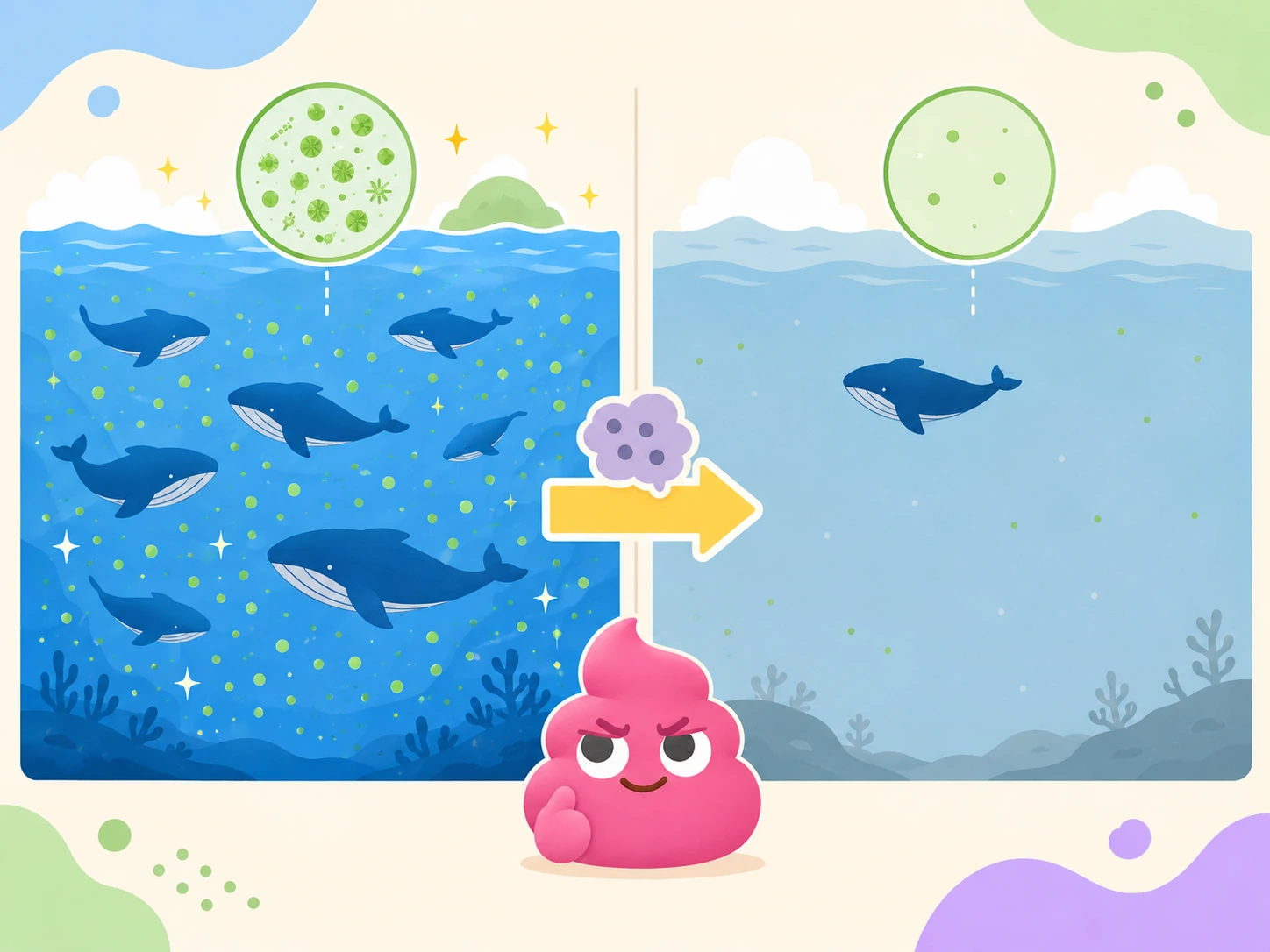
The hopeful part: whale populations have been slowly recovering thanks to conservation efforts, and along with them, the ocean’s nutrient cycling is gradually returning. Protecting whales is, in a real sense, protecting me, and protecting Earth. That is the message marine biologists keep returning to, and it starts with a single whale’s daily release.
What is also striking is that whales pump nutrients sideways too, not just vertically. Migrating whales move from rich feeding grounds in the polar regions to nutrient-poor calving grounds in the tropics, releasing nitrogen and other nutrients along the way. So a single whale during its lifetime acts as both an elevator (deep to surface) and a conveyor belt (cold seas to warm seas). Few other animals operate at that geographical scale, which is exactly why whale conservation gets serious attention from climate researchers.
One Thing You Can Do Today
Compared to whales, your daily output may feel tiny. But the principle is identical. Every living thing’s waste becomes someone else’s food, somewhere downstream. For whales, it is phytoplankton. On land, it is microbes in soil. Even in a wastewater treatment plant, microbes do the final breakdown and return clean water to the system.
So tomorrow, try seeing me not as something dirty, but as a small node in Earth’s nutrient cycle. Whales lift nutrients from the deep to the surface; you sit at the human end of an equally real cycle, just at a different scale. Even if it is small, your daily output is genuinely feeding something, somewhere, every single day.
Logging your daily moments in the unchikun app makes your own rhythm visible. You will not match a whale’s scale, but quietly noticing your own piece of the cycle has a way of making the ocean itself feel a little closer.
Summary
A whale’s poop fertilizes phytoplankton at the surface, which then generate oxygen and absorb atmospheric CO2. Saying it quietly cools the planet is honestly not an exaggeration. Tomorrow’s release of yours operates on a far smaller scale, but it is the same kind of node in the same kind of cycle. Send it off tomorrow with a little bit of quiet pride.