“The morning after a late night, my stomach just feels off.” If that thought has ever crossed your mind, here is something most people never learn: I do my best work while you are asleep. Today, let me walk you through what actually happens inside your gut at night, and one tiny change you can make tonight to wake up to a better tomorrow.
The Origin of This Quote
Your body has something called the autonomic nervous system — a behind-the-scenes system that runs without you thinking about it. It has two settings: the action-mode sympathetic branch, and the rest-mode parasympathetic branch. The gut moves best when the parasympathetic branch is in charge — that is, when you are relaxed, and especially when you are sleeping.
During sleep, particularly during deep non-REM phases, the gut performs something called the MMC (Migrating Motor Complex) — large, sweeping waves that act like a nightly cleaning crew. They push leftover food residue from earlier in the day forward through the small intestine. Crucially, MMC only happens on an empty stomach, so eating heavy late at night essentially cancels the cleaning shift before it can even begin.
The other big factor is your circadian rhythm. Your gut has its own internal clock, and it expects to wake, feed, and rest at predictable times. Inconsistent bedtimes or chronic late nights desync that clock, which is exactly why your morning bathroom timing falls apart after a few off-schedule nights. Lack of sleep also raises cortisol, the stress hormone, which actively slows gut motility — a double penalty.
In short: good sleep equals a good morning poop. The gut isn’t really straining to work for you while you are awake. It is quietly tidying up everything while you are asleep.
Unchikun’s Take
The way I see it, the nighttime gut is the cleanup shift after closing time. During the day, customers (food) keep arriving, so I’m out front, smiling and handling traffic. But once the shop closes and the lights go down, the real cleaning and prep starts. That is the work I do while you sleep.
Staying up late is like delaying the closing time. Cleaning hours get cut, and the next morning I open up still half-cluttered. That is why poop on those mornings often feels harder to pass, or somehow incomplete. After a few nights in a row, the whole shop starts to feel a little messy.
There is also a second player here: the good bacteria living in your gut. They have their own circadian rhythm, just like you. They strongly prefer a host who actually sleeps when night comes. Stay up too many nights in a row, and the bacterial balance slowly tilts off-center, which then shows up as changes in my shape and color. Sleep is the foundation that holds the whole gut-bacteria team together.
People talk about “eating more fiber” for constipation — and yes, fiber matters. But honestly, the most efficient gut-care move is simpler than that: sleep. You don’t have to buy anything, you don’t have to go anywhere. You just sleep. And tomorrow morning’s me changes because of it.
One Thing You Can Do Today
Tonight, try finishing dinner at least three hours before bedtime. That single shift makes the MMC cleaning waves much more likely to fire while you sleep.
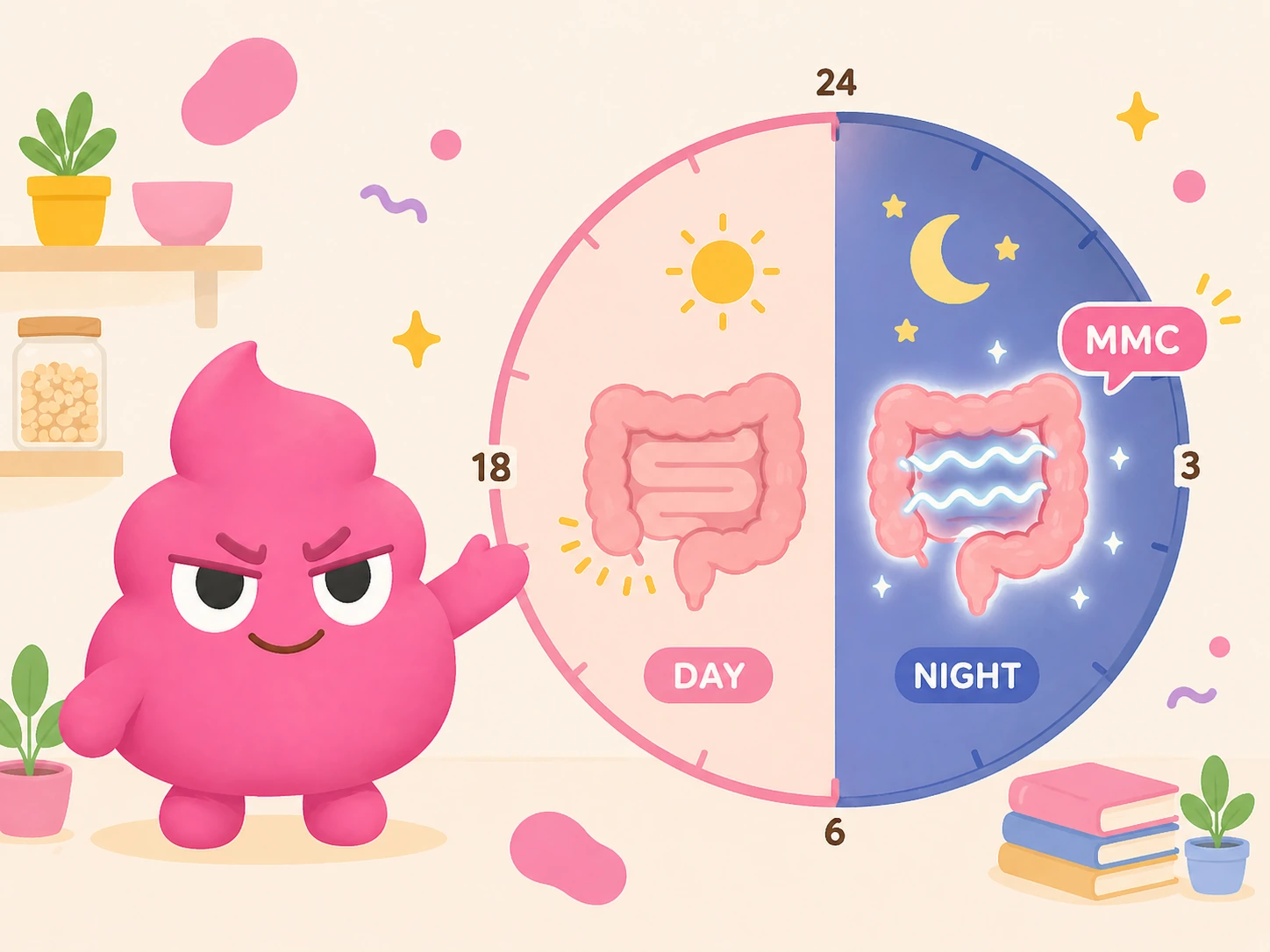
Ideally, your stomach should be empty by the three-hour mark before bed. If food is still being digested, your sympathetic nervous system stays busy with that work, which makes it harder for the parasympathetic system to take over — and harder for you to fall into deep sleep. People who routinely eat late or snack right before bed see the biggest jump from changing this one thing.
For the days when timing slips, here is a backup tip: keep your bedtime fixed, even if dinner runs late. The circadian rhythm responds more to the consistency of when you sleep than to perfect sleep quality. Locking in a steady bedtime is a more realistic, sustainable lever than trying to optimize every variable.
Your phone matters too. Try setting it down on the bedside table thirty minutes before sleep. Blue light tickles the sympathetic system and delays the switch to relaxation mode. Replace it with a warm tea or some plain warm water and a few slow breaths. That is enough to tell your body, “okay, sleep is coming.”
If you log my morning shape in the unchikun app, you’ll start to see the actual difference between well-rested nights and late ones. It becomes a small experiment with your own body — and that visible feedback is often what turns a vague intention into a real habit.
Summary
Bedtime is, for me, when the real shift starts. What you eat during the day matters, but the night’s sleep is the foundation that quietly fixes everything else. Tonight, finish dinner just a little earlier than usual, and get into bed at your usual time. Tomorrow morning, I’ll probably show up to say hello.