Did you know that newborn koalas literally cannot digest eucalyptus leaves at first? They simply do not have the special bacteria that break down the toxins inside those leaves. So how do they ever acquire those bacteria? They eat their mother’s poop. Today, let me walk you through one of the most genuinely touching stories in all of animal biology — the story of life passing forward through poop.
The Origin of This Quote
Koalas are eucalyptus specialists. They eat almost nothing else, all day, every day. But eucalyptus leaves are packed with tannins, essential oils, and other compounds that are actively poisonous to most mammals on Earth. To survive on a eucalyptus-only diet, koalas need a gut populated by highly specialized bacteria capable of breaking those compounds down into something safe and useful.
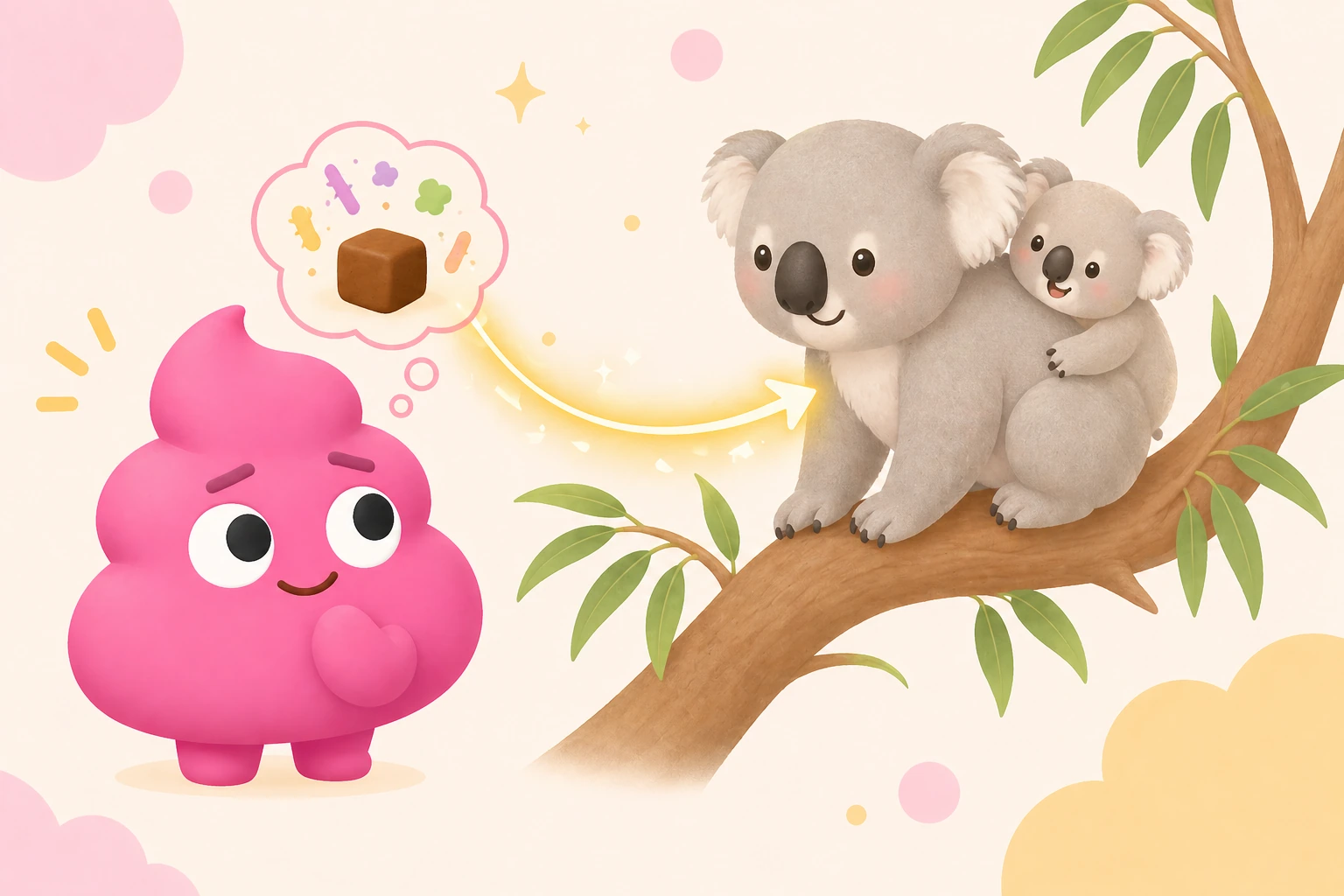
The catch is that newborn koalas are not born already carrying these bacteria. While they are still in the pouch drinking milk, that is no problem. But as they approach weaning age and need to switch over to eating real eucalyptus leaves, they need to somehow acquire the gut microbiome that makes that diet survivable. The koala solution is a behavior known in koala biology as “pap-feeding”.
The mother produces a soft, partially-digested substance from her caecum, which the baby koala eats directly. This substance is called pap, and it is biologically distinct from normal koala poop. It is a half-liquid mixture loaded with exactly the gut bacteria her baby needs. By eating it, the baby koala inherits, in one single act, a lifetime’s worth of eucalyptus-breaking microbial allies — handed straight from mom.
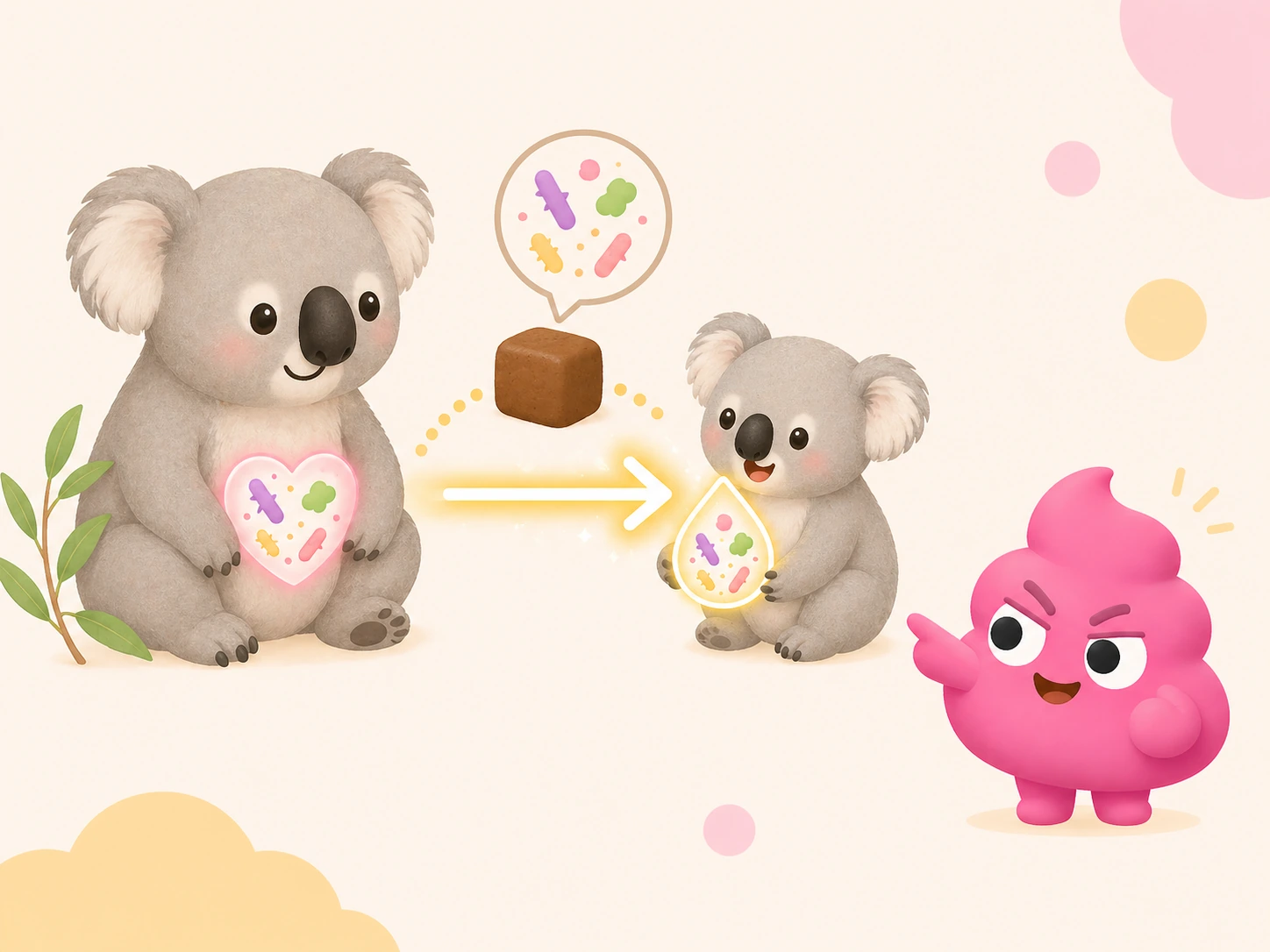
What this really means is that gut bacteria themselves are being transmitted from mother to child. The baby koala’s first true meal beyond milk is, of all things, a microbial gift from mom’s own gut. What is being inherited here is not nutrition. It is the seed of an entire living system that allows the baby to be alive at all.
Unchikun’s Take
From my point of view, koala pap-feeding is the most beautiful example of “poop as a relay baton of life.” Usually I am thought of as the leftover, the post-script of digestion, the part you flush. But in the koala world, I become the seed that keeps the next generation alive. The framing flips one hundred and eighty degrees. It is honestly one of the loveliest things biology has come up with.
Human babies, while not as dramatic as koalas, actually do something surprisingly similar. During vaginal birth, the baby passes through the mother’s birth canal and is exposed to her gut and vaginal bacteria, which become the founding seed for the baby’s own microbiome. Research has shown that babies born by cesarean section have a slightly different microbiome composition for years afterward — another quiet illustration of mother-to-child microbial inheritance happening in our own species.
Gut bacteria, in other words, can be thought of as a second inheritance system running in parallel with DNA. DNA you inherit roughly half from each parent. The microbiome, you inherit primarily from your mother. Koala pap-feeding is just the most visible, most obvious version of a story that quietly plays out across most mammals on the planet.
Mammalian motherhood, then, is not just “providing milk” — it is also, very deeply, providing microbes. Across millions of years of evolution, mothers have not only fed their babies but also handed down the entire living machinery that makes life on this planet possible for their offspring. I sit at the very front of that line. An invisible but utterly decisive letter from one generation to the next.
One Thing You Can Do Today
Here is a slightly unusual one for tomorrow. The next time you wake up, try silently saying “thank you” to your own gut.
We barely think about gut bacteria in daily life. But inside your gut right now, there are over one hundred trillion bacteria, and the great majority of them are descendants of the bacteria you inherited at birth from your mother. Decades later, those exact same lineages are still alive in you, working away every single day, every single hour. When you actually pause and let that sink in, it is genuinely quietly moving.
In the koala world, this inheritance is visible — pap is the literal physical handoff event. In the human world, the same exact thing happens, just invisibly, at the microbial level rather than the visible one. I am, in a real sense, the occasional visible letter from that invisible inheritance.
When you log my daily condition in the unchikun app, what you are actually tracking is not just “today’s health barometer” in some abstract sense. It is also, more deeply, a quiet record of how the microbes you inherited from your mother are doing right now, today.
Summary
Koala pap-feeding is the clearest, most touching window we have into the relay race of life through poop. Gut bacteria are something like a second inheritance, running alongside DNA, threaded through generations of mammals. Tomorrow morning, when you see me, take a small moment to remember the one hundred trillion invisible companions that originally came to you from someone who loved you first.