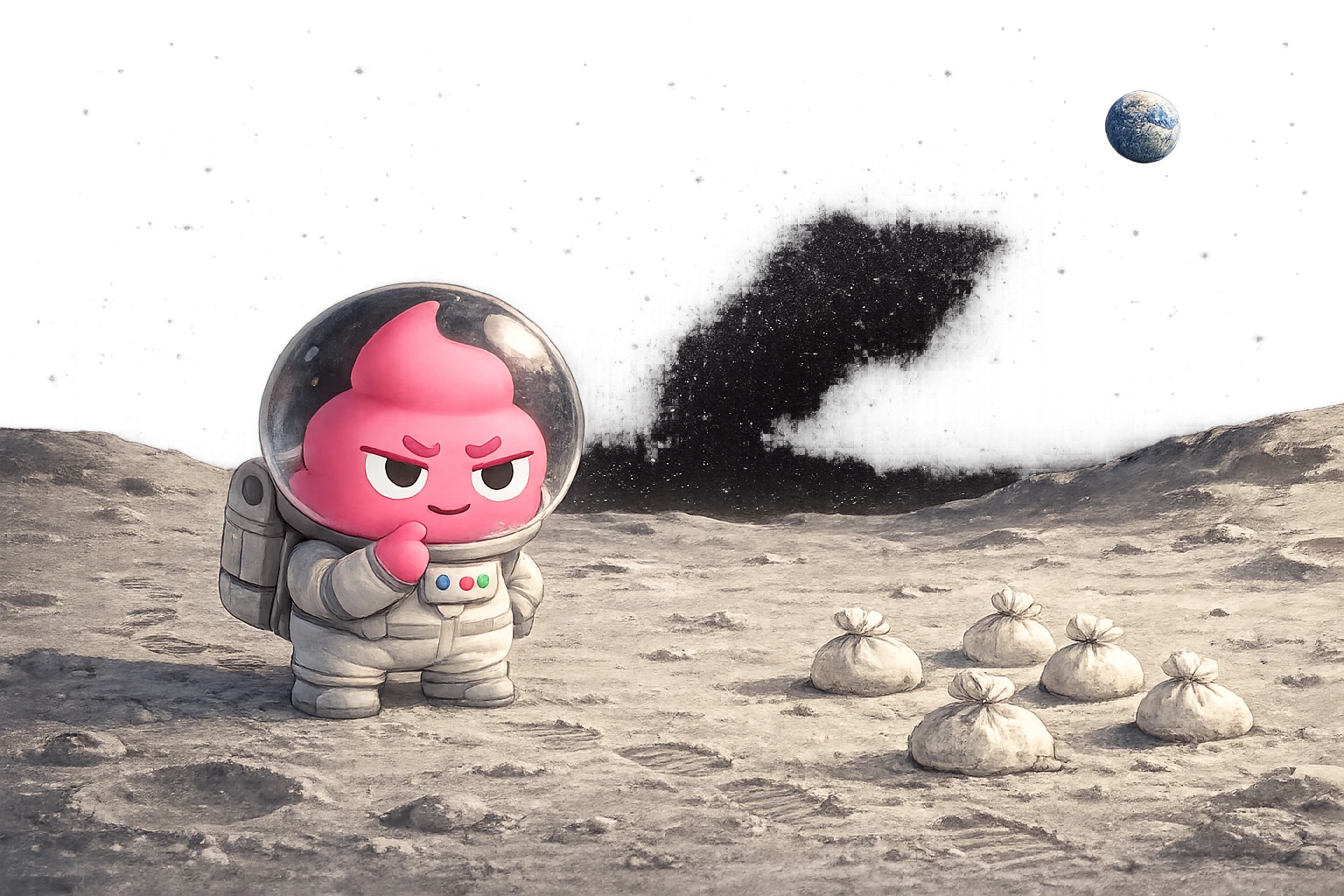
Look up at the moon tonight. On that silver surface, about 96 of my fellow poop bags are still sitting there. Not a joke — it’s a true story. Today I want to tell you the surprising tale of the moon’s quietest visitors.
The Origin of This Quote
Between 1969 and 1972, NASA’s Apollo program put humans on the moon six times — Apollo 11, 12, 14, 15, 16, and 17. The “one giant leap for mankind” missions you’ve definitely heard about.
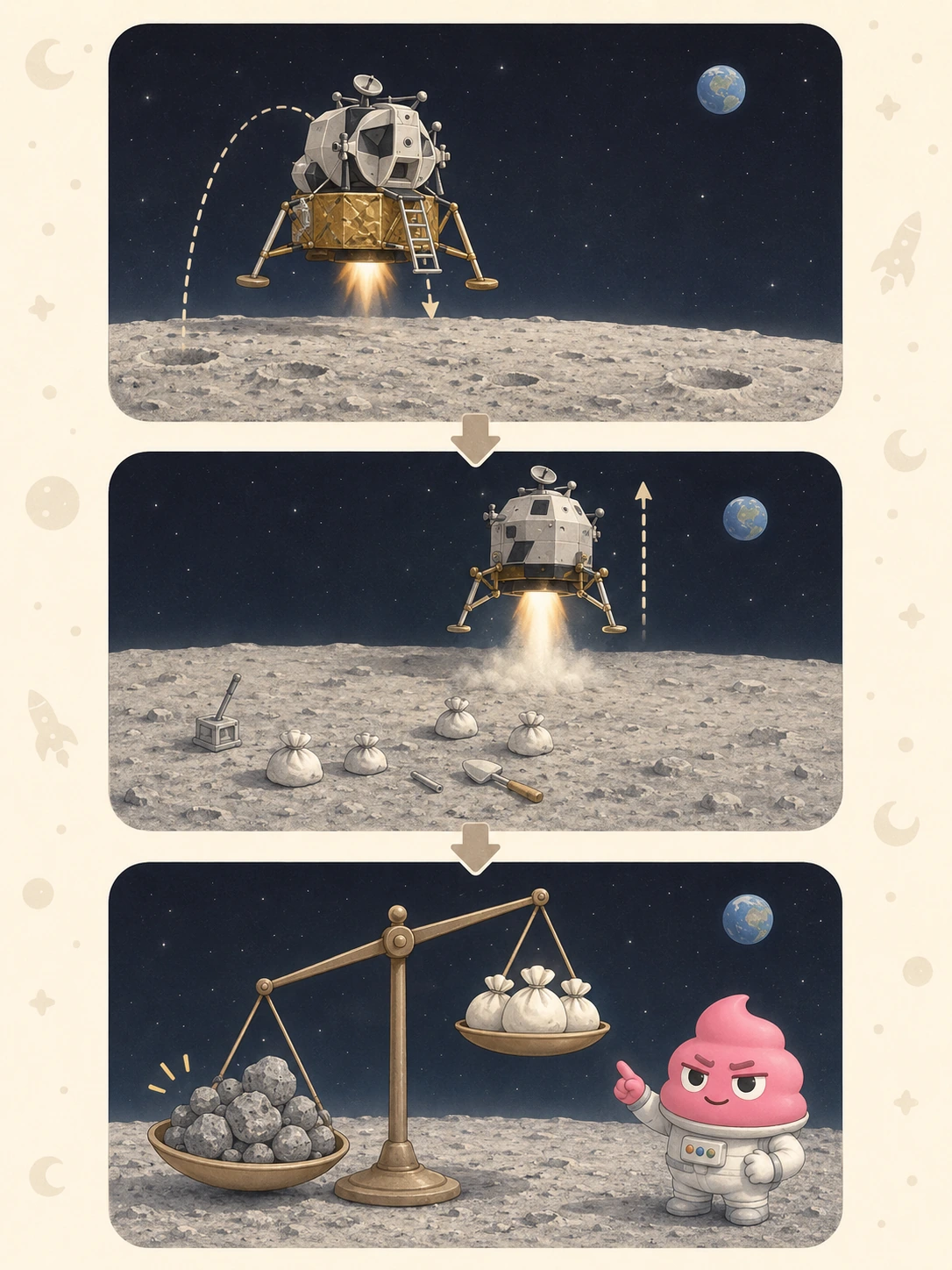
When the Lunar Module’s ascent stage took off from the surface, the astronauts wanted it as light as possible. The lighter the climb, the less fuel they burned, and the more lunar rocks they could carry back to Earth. So before launching, the crew jettisoned anything they didn’t need — used tools, spare equipment, life-support cassettes, and yes…
Used poop bags. According to compiled NASA records and research summaries, across all six landings about 96 human-waste jettison bags were left on the moon. In effect, we got traded for lunar rocks and left behind in the gray dust.
“That’s just gross, right?” — wait. NASA scientists today don’t see those bags as trash. They see them as one of the most valuable accidental experiments on the limits of life ever set up.
Unchikun’s Take
The lunar surface is nothing like Earth. It’s a hard vacuum with no atmosphere, blasted by UV and cosmic rays, swinging from over 120°C in sunlight to about −170°C in shadow. Almost any organism you know would die in moments.
But inside my bags are billions of Earth microbes — E. coli, gut bacteria, skin bacteria, lactic acid bacteria — the ones we live with every day. They have now been sitting on the moon, in vacuum and radiation, for roughly half a century. If even a single dormant microbe in there is still viable, that would be the first hard data ever recorded on how long Earth life can survive in the open space environment.
NASA’s Mark Lupisella and other researchers have publicly proposed that, when Artemis returns humans to the moon, a mission should collect at least one of those old jettison bags and bring it back as a sample. If something is still alive, that’s evidence Earth life can quietly endure on another world. If everything is dead, we still learn a hard upper bound — how long it took for life to lose. Either way, it’s gold.
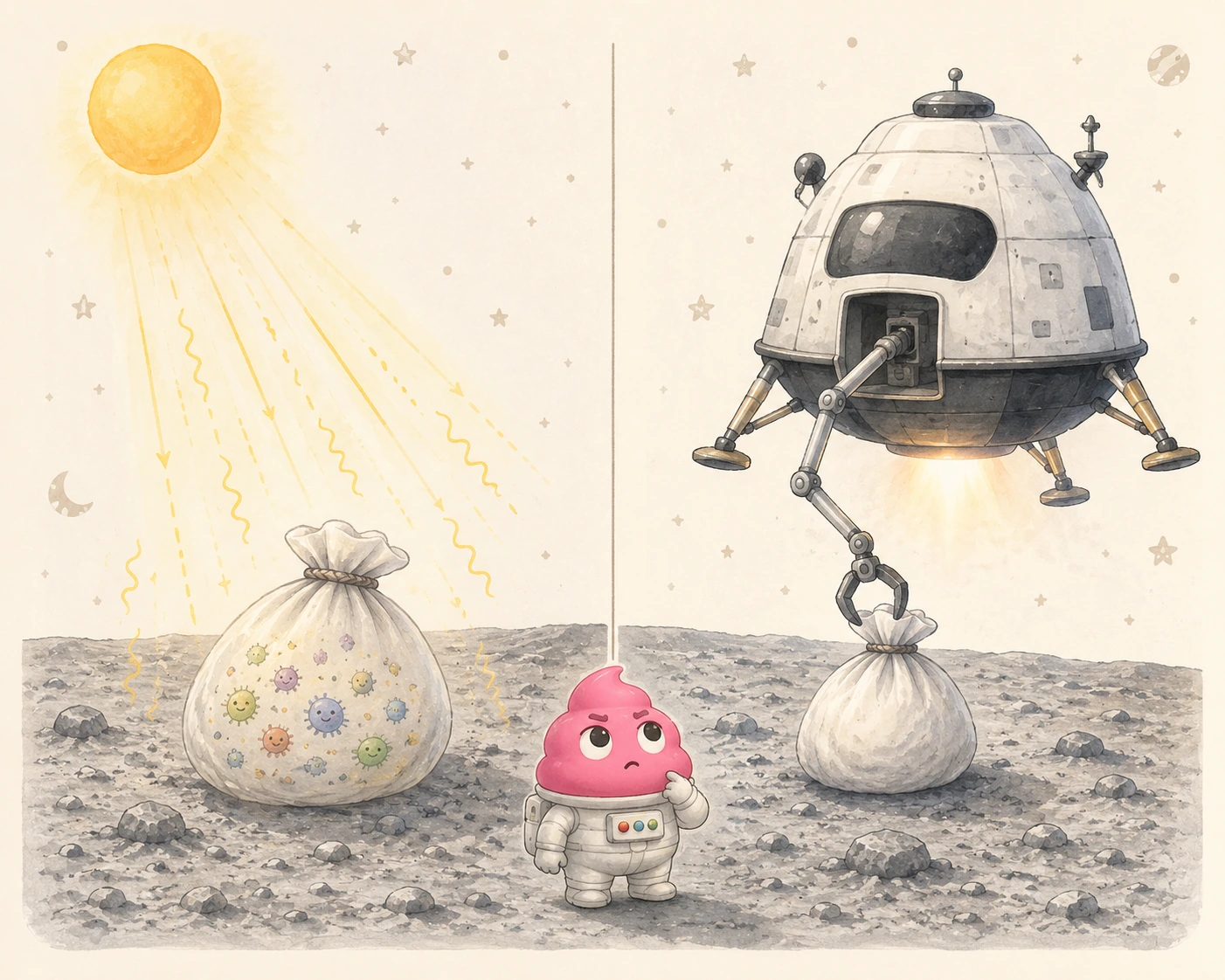
There’s a second reason this matters: planetary protection. When humans send probes to Mars or to icy moons like Europa and Enceladus, we have to know how easily Earth microbes can hitch along and contaminate other worlds. If a probe accidentally carries living bacteria, and those bacteria thrive in alien soil, we may never be able to tell whether a discovered organism was truly native or one we brought along ourselves. Knowing exactly how long bacteria can survive in open space isn’t just trivia — it’s the safety design rulebook for every future mission, and ultimately a question about how we behave as a spacefaring species.
The Apollo bags also matter because they are passive samples. Unlike a lab experiment, no one cared for them, replenished nutrients, or shielded them. They were dropped and forgotten. That accidental quality is what makes them so valuable — a clean, hands-off, decades-long stress test that nobody could ever run on purpose in an ethics committee.
One Thing You Can Do Today
Down here on Earth, I’m just “the thing you flush.” But once you hear the moon-bag story, you start to see me a little differently. Each bag is, in effect, a tiny biological laboratory holding trillions of microbes that lived with one specific person. Vacuum-sealed for half a century on another world, that became science.
Next time you see your own me off, take a small second to picture it. Inside is a complete microbial portrait of the day. Down here, gravity and plumbing make it disappear. Out there, the very same thing turns into the longest-running survival experiment in human history.
The Unchikun app records yours one entry at a time. Tiny on its own, but as the records pile up, the rhythm of your body becomes visible — same idea as moon samples: dots become lines once you keep collecting them.
Summary
On that bright silver surface up there, about 96 poop bags are quietly waiting. Left behind because moon rocks were heavier, they are slowly becoming one of the oldest space experiments humanity has ever set up. Next time the moon is full, give it a small nod. Up there, the elders of my kind are still listening to the universe — humanity’s most unexpected souvenir.