Hard-to-believe fact incoming: in Edo-era Japan, people were paid for their poop. Not by accident — this was a fully functional circular economy that kept what was then the world’s largest city famously clean for centuries. Today, let me walk you through the surprising story of how I, under the name “shimogoe,” ran one of the cleanest cities in pre-industrial human history.
The Origin of This Quote
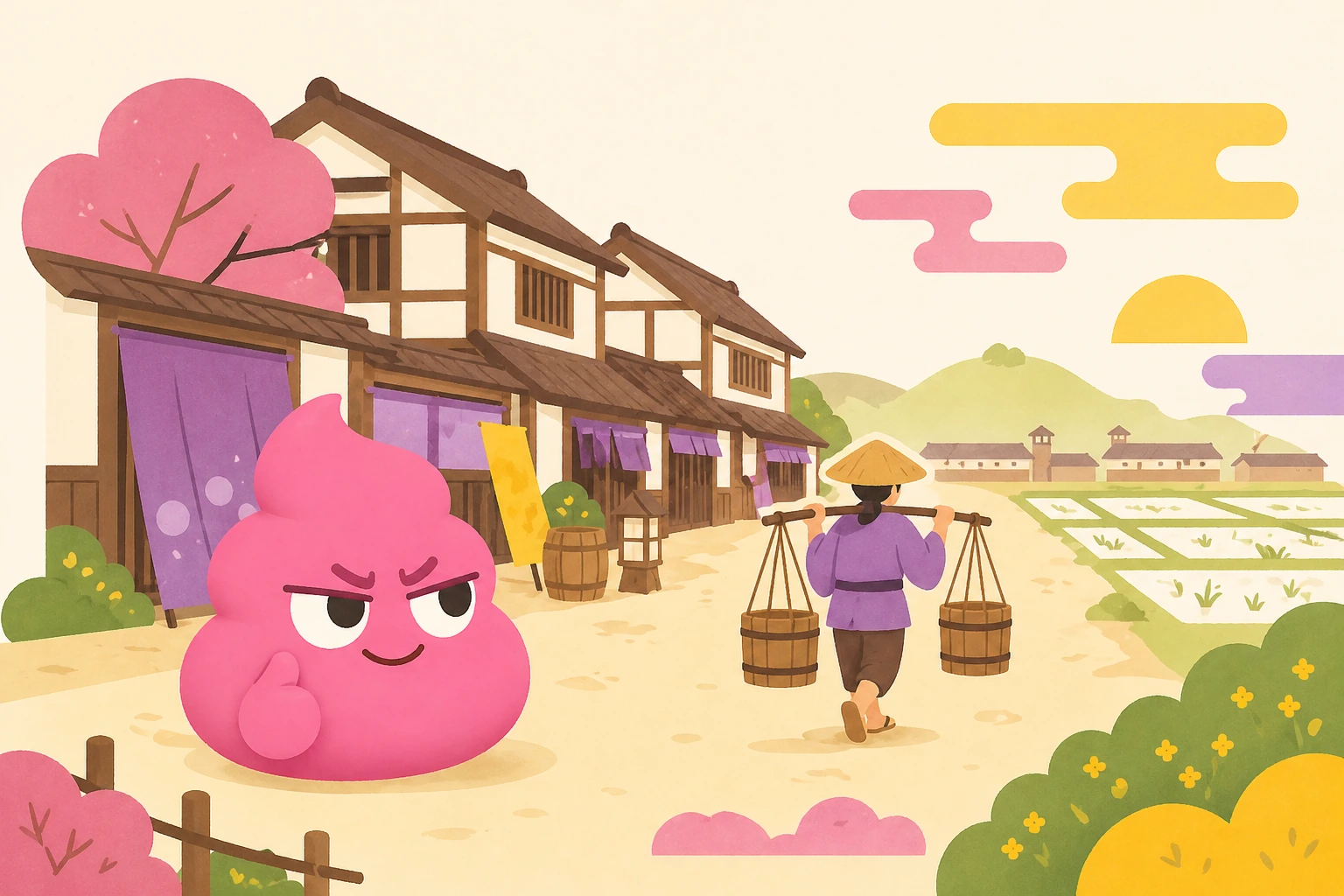
Edo-era Japan, particularly the city of Edo (modern Tokyo), grew to over one million people, making it one of the largest cities in the world at the time. While London and Paris were notoriously struggling with sewage overflowing into their streets, Edo was instead remarked upon by foreign visitors as “one of the cleanest cities in the world.”
The reason was beautifully simple. Human poop was an actual paid commodity. Farmers from the surrounding countryside visited residential blocks on a regular schedule as collection contractors, picking up poop in exchange for cash or vegetables. This system had a name: shimogoe (下肥), literally “lower fertilizer.” Far from being trash, this was a thriving, respected, and well-organized business.
Shimogoe was not just any garbage. It was prized organic fertilizer, packed with nitrogen, phosphorus, and potassium — the three nutrients that growing plants need most. In an era before chemical fertilizers existed, it was indispensable. Farmers around Edo would buy it, spread it on their fields, grow vegetables and rice, and sell that food back to the people of Edo. A perfect circular economy had naturally formed and ran continuously for over two centuries, without anyone needing to design it from above.
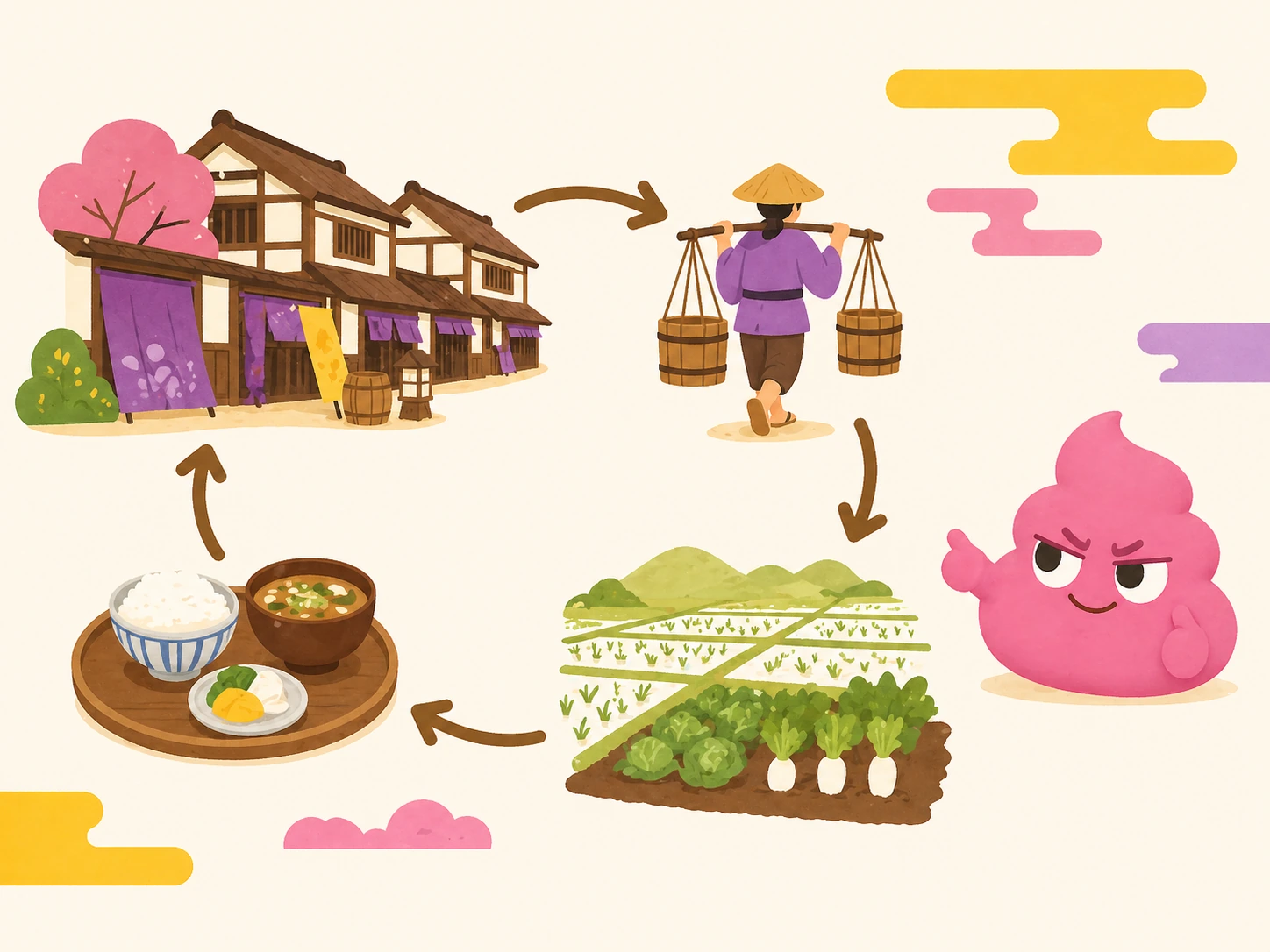
What is even more interesting is that prices varied by class and diet. Poop from samurai households, where residents ate well — refined rice, fish, balanced meals — was richer in nutrients and reportedly fetched higher market prices than poop from poorer city neighborhoods. There was a literal class hierarchy of poop value. Very Edo.
Unchikun’s Take
From my point of view, the Edo era was nothing less than a golden age for poop. Today, I am flushed and forgotten within seconds. Back then, I was treated as a moving piece of the actual economy. To the people of Edo, I was not “smelly” or “dirty” in the modern judgmental sense — I was a vital resource that fed the fields and grew the food.
The reason this lasted for centuries was that it was a genuinely brilliant system. The city stayed clean (no sewage piling up in the streets), farmers fertilized their crops without paying for expensive imported chemical inputs, and city dwellers received either cash or fresh vegetables in return for what they otherwise would have just discarded. Everyone benefited from a system that emerged organically over time.
The Meiji era eventually brought imported chemical fertilizers, and the shimogoe trade gradually faded into history. In exchange for convenience and modernization, the loop got quietly broken. Today, in the twenty-first century, sustainability and circular economy are buzzwords on every conference stage. But three hundred years ago, Edo was already running one as a normal part of daily life. That fact alone is, honestly, worth pausing to appreciate.
I remember, in some abstract sense, being something other than mere waste. Biogas, methane fermentation, and modern composting are gradually starting to reclaim my role as a resource again. My future is not necessarily just garbage — and Edo’s quiet history is the proof of that.
One Thing You Can Do Today
Tomorrow morning, when you meet me in the bathroom, try silently saying to yourself: “you used to be shimogoe.”
We see me, by default, as a “flush and forget” object. But until only about one hundred and fifty years ago, humans for centuries saw me as a vital part of the circle of soil and life. Historically speaking, the “flush and forget” era is actually the unusual short-lived one, not the natural baseline state.
When you reframe it that way, daily me looks slightly different, does it not? I am the result of what you ate yesterday, yes — but more deeply, I was originally the substance that would grow the next meal you would eat. Even if I get flushed away today, the nutrients and cultural memory both still exist inside me.
Logging your daily me in the unchikun app is, in some quiet way, a form of treating me with respect. People in Edo evaluated my form and quantity for fertilizer value, every single day. Modern you observes my form and color to read your own body’s state, every single day. The culture of observing me has been continuous through history, just shifting in shape from one century to the next.
Summary
Edo-era me was the lead actor in the cycle that kept the city clean, fed the farms, and powered the economy. Even today’s flush-and-forget me was, very recently in historical terms, on the side of growing life rather than ending up as waste. Tomorrow morning, when you see me, take a small moment to feel the surprising historical weight inside something you might have thought was ordinary.