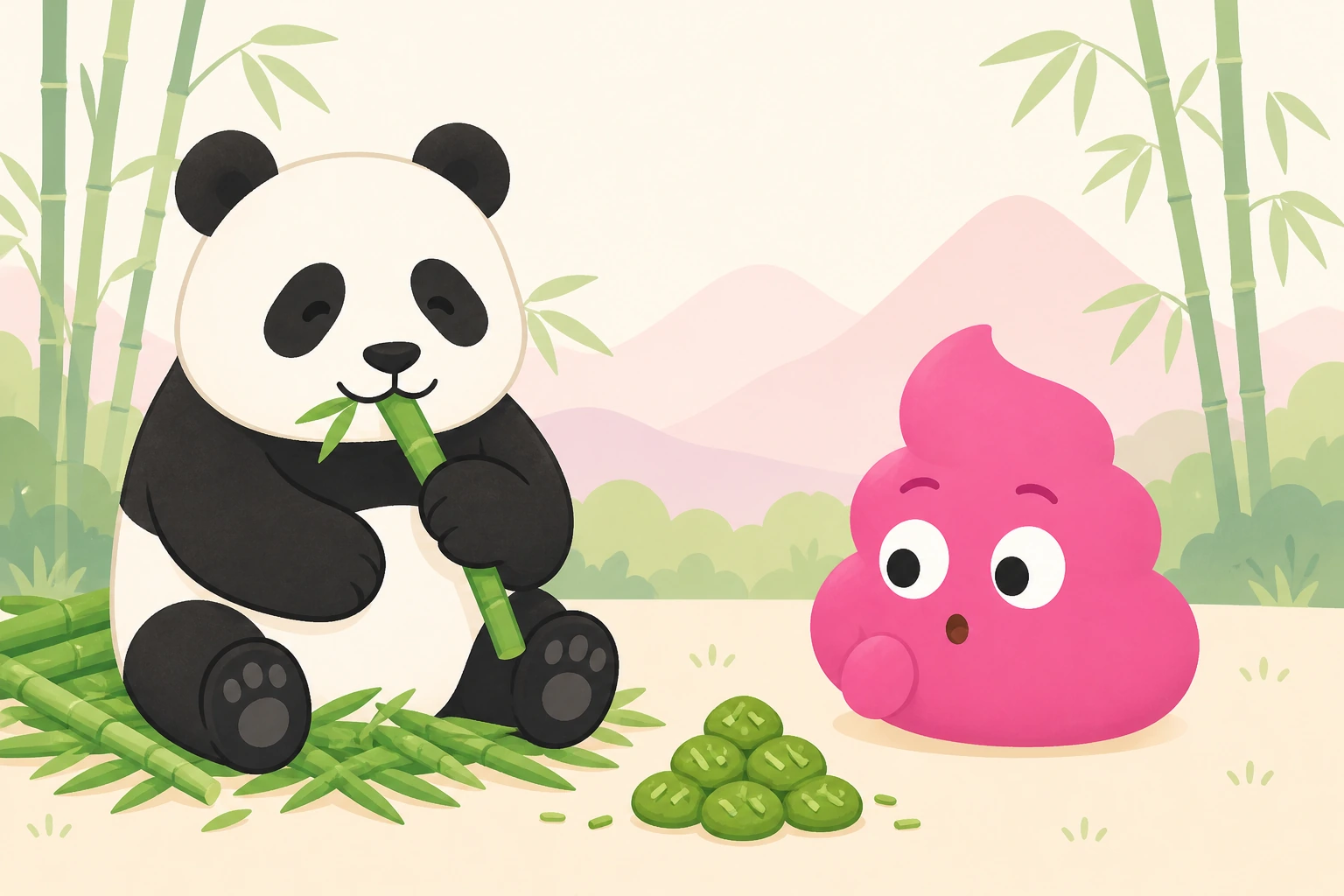
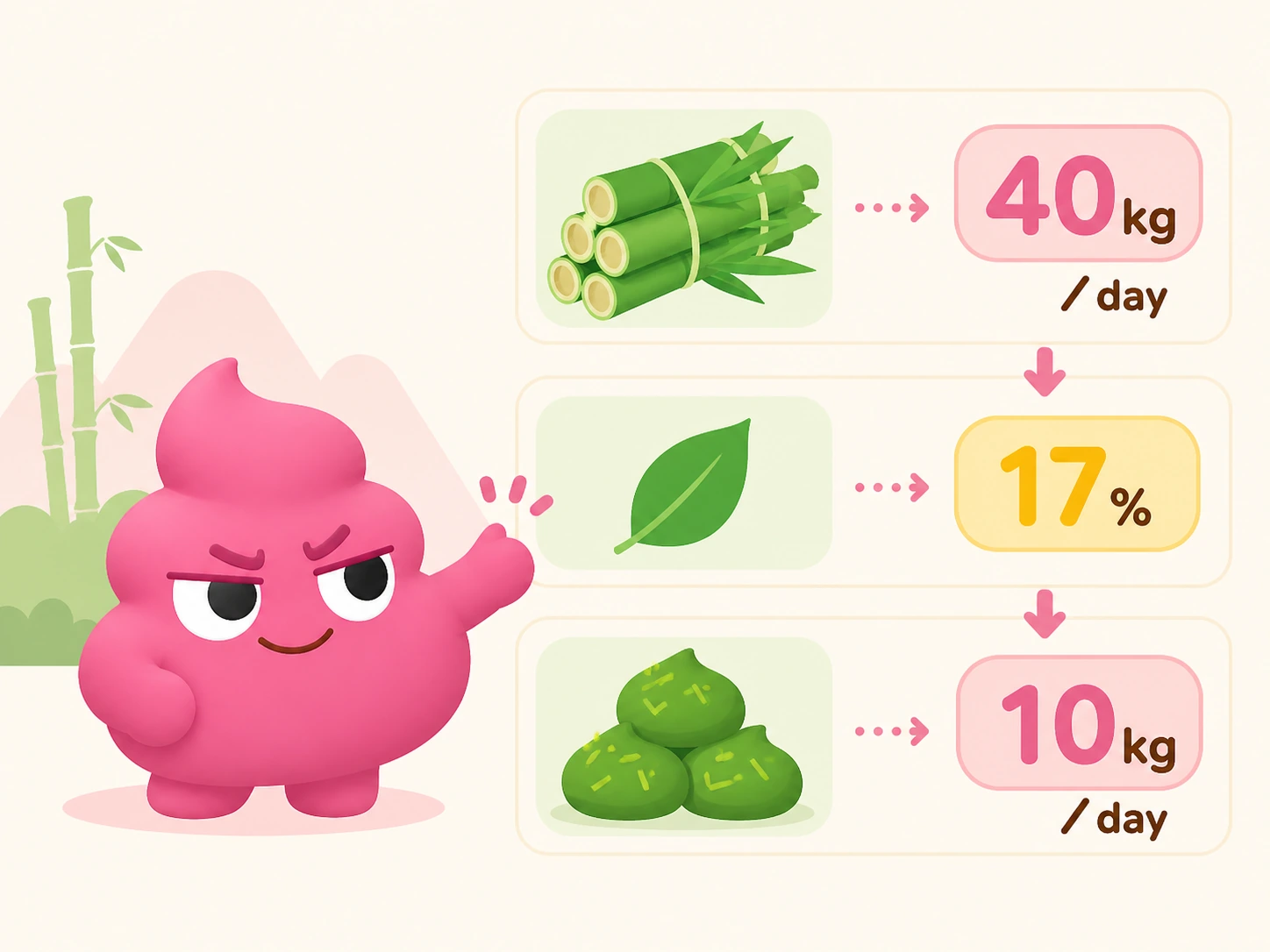
Giant pandas look like plush toys, but the situation inside their bellies is brutal. Honestly: they eat 40 kilograms of bamboo a day and push out around 10 kilograms of poop in return. Today, let me walk you through what is happening inside a panda’s gut, and what it secretly teaches us about reading our own daily poop.
The Origin of This Quote
Here is the surprise that catches most people off guard. Taxonomically, the giant panda belongs to the order Carnivora — the same group as bears, lions, and wolves. Their teeth, the length of their digestive tract, and their digestive enzymes are all still configured for a carnivore.
And yet, what they actually eat is bamboo. Pandas spend roughly fourteen hours a day chewing bamboo, and bamboo accounts for about 99% of their diet. They literally cannot survive without it. This is so unusual in the animal kingdom that scientists have a name for it: an “evolutionary mismatch.”
The result is harsh. A carnivore’s gut can barely digest bamboo, and a panda’s actual nutrient absorption rate sits around 17% — far below the 40%-plus you see in true herbivores like cows. To compensate, a panda has to eat 12–40 kilograms of bamboo a day, and the leftover bamboo simply passes through. That is why pandas produce roughly 10 kilograms of poop daily, with bamboo fibers still recognizable inside — sometimes you can even spot intact leaf shapes.
There is more. The umami receptor gene (T1R1) in pandas is broken at the genetic level, so they likely cannot taste meat the way other carnivores do. Why and when this shift to bamboo happened is still not fully understood by science.
Unchikun’s Take
The way I see it, the panda’s gut is like a kitchen built entirely for cooking meat, but only ever asked to make bamboo salad. The knives, cutting board, and pots are all configured for the wrong dish. Efficiency is awful. So the only way to get enough nutrition is to shove huge volumes through — and whatever cannot be processed comes straight out the other side. That is why panda poop has bamboo fibers in plain sight.
For me, watching it is genuinely overwhelming — “are you sure you can eat that?” volumes — but for the panda, this is the right answer. It is also a real-world example that even when your body is mismatched with your food, sheer volume and time can compensate. Fourteen hours a day. Almost every waking moment is eating. That is panda life.
For humans, the situation is much kinder. Omnivores get a flexible gut that can handle meat, vegetables, grains, and fermented foods all at once. But even with that flexibility, eating something your body does not handle well leaves a clear signal in my appearance. Lactose-sensitive people who push through daily yogurt get loose stool. Diets heavy on fried food make me harder. Watching your own poop is the most direct way to find out what your body actually likes.
Pandas don’t get to choose. We do. That choice is a quietly enormous freedom.
One Thing You Can Do Today
After today’s meals, just glance at my shape and color in the bowl. That’s it.
Humans don’t carry the panda-level mismatch of “eat bamboo with a carnivore’s gut,” but everyone has their own personal list of foods that work and foods that don’t. Lactose intolerance, gluten sensitivity, certain vegetables that bloat you, oily foods that wreck the next morning. None of these are diseases — they are simply where your particular gut is most comfortable.
The most honest signal of “this works / this doesn’t” is, well, me. Shape, color, smell, frequency. If your usual banana shape collapses into mush one morning, think back to what you ate the night before. If the same pattern repeats weekly, it might be a food that doesn’t agree with your gut.
Logging me in the unchikun app each day surfaces patterns you’d otherwise miss — “this menu always softens me the next morning,” “this drink tilts me darker.” You don’t have to dedicate fourteen hours a day to your gut like a panda; you just have to ask me, and I’ll tell you what your body really thinks.
Summary
The panda’s body deals with an evolutionary quirk by trading volume and time for efficiency. Humans don’t have to live like that, but we still each have our own personal “what fits, what doesn’t” list — and the most honest answer is sitting in the toilet bowl. Today, just take a small look. That single glance is the most realistic gut-care lesson a panda can teach you.